
Eighty-eight percent of marketers say they use AI. But when Duke, Deloitte, and the AMA dug into the numbers for the 2025 CMO Survey, the real figure was far less impressive: AI powers just 17.2% of actual marketing activities. That gap — between “we have ChatGPT” and “AI is embedded in how we work” — is where most teams are stuck right now.
And it gets worse. Nearly half of companies abandoned their AI projects entirely in 2025, according to S&P Global. Only 49% of marketers bother measuring AI ROI at all.
This guide is built around a simple premise: knowing about AI marketing isn’t the problem anymore. Knowing how to use it — which workflows, which tools, which metrics, and which emerging channels to prioritize — is what separates teams that get results from teams that get a subscription they barely touch. Here’s how to close that gap.
What Is AI Marketing and Why It Matters in 2026
AI marketing is the application of artificial intelligence technologies — natural language processing, machine learning, predictive analytics, and generative AI — to plan, execute, and optimize marketing activities. That’s the textbook version. The practical version is simpler: it’s using machines to do the parts of marketing that scale poorly when humans do them alone.
The field has evolved in three distinct waves. First came rules-based automation — if a lead scores above X, send email Y. Then generative AI arrived, and suddenly marketers could draft blog posts, ad copy, and entire email sequences in minutes instead of hours. Now we’re entering the third wave: AI agents, autonomous systems that can execute multi-step marketing workflows without constant human oversight.
The adoption curve reflects this acceleration. Daily AI usage among marketers jumped from 37% to 60% in a single year (Social Media Examiner, 2025). Generative AI specifically surged 116% year-over-year in marketing activities, per the CMO Survey. And 94% of marketers plan to use AI in content creation this year, according to HubSpot’s survey of 1,500+ marketers.
But the numbers that matter most aren’t about adoption — they’re about depth. Only 13% of marketing teams have moved into agentic AI, yet those early adopters report twice the performance of underperformers and 20% higher ROI, per Salesforce’s survey of 4,450+ marketers. The takeaway: using AI isn’t the advantage anymore. How deeply you use it is.
One more shift makes 2026 a genuine inflection point. AI hasn’t just become a better marketing tool — it’s become a marketing channel. ChatGPT now reaches over 800 million weekly active users. Google AI Overviews serve 2 billion monthly users across 200+ countries. Half of all Google searches now include an AI Overview. When consumers ask AI which product to buy, which service to hire, or which brand to trust, your visibility inside those AI-generated answers matters as much as your Google ranking. More on that in the sections ahead.
The operating model that works in 2026 is augmentation, not replacement. AI handles volume, pattern recognition, and speed. Humans handle strategy, judgment, and the kind of creative thinking that makes a brand feel like something worth caring about.
Key Use Cases — How Marketers Are Actually Using AI
The gap between “AI can do everything” and “here’s what actually moves the needle” is wide. These are the use cases where AI delivers measurable results — not theoretical ones.
Content Creation and Repurposing
This is where most teams start, and for good reason. AI users publish 42% more content per month than non-users (17 articles versus 12, per Ahrefs). The cost difference is stark too — human-written content costs 4.7x more than AI-generated content.
But raw output isn’t the goal. NielsenIQ ran an EEG study with over 2,000 participants and found that AI-generated ads trigger weaker memory activation in the brain. Consumers rated them as more boring and more annoying. And human-generated content still pulls 5.44x more traffic than pure AI content.
The winning approach is hybrid. Use AI for research, outlines, first drafts, and repurposing across formats. Then layer human expertise on top — original insights, brand voice, emotional resonance. HubSpot’s data backs this up: only 4% of marketers use AI to write entire pieces, while 56% make significant edits. AI-enhanced content (human plus AI) consistently outperforms either approach alone.
Personalization and Audience Segmentation
Seventy-one percent of consumers expect personalized interactions, and 80% are more likely to purchase when that expectation is met (McKinsey). AI makes this possible at a scale that manual segmentation never could — analyzing behavioral patterns, purchase history, and engagement signals across millions of customers simultaneously.
Real-time AI personalization delivers 20% higher conversion rates than batch approaches. L’Oréal’s ModiFace virtual try-on tool, powered by AI personalization, has processed over a billion virtual try-ons and tripled conversion rates. Nike’s predictive models analyze app usage and social signals to deliver ultra-personalized recommendations, driving up to 30% higher repeat purchase rates.
Predictive Analytics and Lead Scoring
Thirty-six percent of marketers now use AI for data analysis (HubSpot). Predictive analytics goes beyond reporting what happened — it forecasts which leads are most likely to convert, which customers are at risk of churning, and which campaigns will underperform before you spend the budget.
The practical application is straightforward: feed your CRM and behavioral data into a predictive model, and let AI prioritize where your team spends its time. The companies seeing real results here are the ones with clean, integrated data — which, it turns out, is the hard part.
Ad Optimization and Programmatic Buying
AI-powered ad campaigns produce 47% higher click-through rates, according to industry analysis. Platforms like Meta Advantage+ and Google Performance Max already use AI to optimize bidding, placement, and creative in real time. Amazon is building tools that let advertisers of any size generate campaign-ready video, audio, and image assets in clicks.
The shift here isn’t gradual — it’s structural. Manual bid management and A/B testing with two variants are being replaced by AI systems that test hundreds of creative combinations simultaneously and allocate budget dynamically.
Email Marketing Optimization
AI-optimized email marketing delivers 41% more revenue. HubSpot’s own AI email campaigns achieved an 82% lift in conversions, with 100-400% increases in engagement through personalization. The applications range from optimizing send times and subject lines to building entire journey sequences that adapt based on individual recipient behavior.
Chatbots and Conversational Marketing
Thirty-one percent of marketers use AI chatbots. HubSpot CMO Kipp Bodnar notes AI can resolve 50-70% of support queries — but warns the remaining cases “might cost MORE to solve with AI than without.” The key is knowing which conversations to automate and which to route to humans. High-stakes, emotionally complex interactions still belong to people.
SEO and Content Strategy
AI tools like Surfer SEO, Clearscope, and MarketMuse have changed how teams approach keyword research, content gap analysis, and on-page optimization. But the bigger story is how AI is reshaping search itself — something we’ll cover in the future-focused section below.
AI Marketing Tools by Function — What to Use and When
Tool sprawl is a real problem. The CMO Survey found that 56.4% of purchased Martech tools go unused. Before adding another subscription, start with what you’re trying to solve.
Content creation: ChatGPT and Claude handle drafting, ideation, and repurposing well. Jasper is built specifically for marketing copy. Synthesia and Runway ML cover AI video. ChatGPT holds roughly 44% market share among marketers, followed by Gemini (15%) and Claude (10%).
SEO and content strategy: Surfer SEO, Clearscope, Frase, and MarketMuse help optimize content for search. Ahrefs and Semrush have integrated AI features across keyword research, content auditing, and competitive analysis.
Ad campaign management: Meta Advantage+ and Google Performance Max are the dominant platforms. Madgicx offers AI-powered optimization for social ad campaigns.
Email marketing: HubSpot, Mailchimp, and ActiveCampaign all have AI features for personalization, send-time optimization, and journey building.
Analytics and reporting: Supermetrics, Looker Studio, and Tableau’s AI features help translate raw data into actionable insights without requiring a data science team.
Social media: Sprout Social, Buffer AI, and Lately handle scheduling, content suggestions, and sentiment analysis.
Workflow automation: Zapier, Make, and Gumloop connect tools and automate multi-step workflows across your stack.
The selection criteria that actually matter: Does it integrate with your existing stack? Does it solve a bottleneck you have today (not a theoretical one)? Can your team realistically learn it? And can you measure whether it’s working? If the answer to any of those is no, the tool will end up in the 56% that collects dust.
How to Build an AI Marketing Strategy — Step by Step
The companies seeing 2x performance from AI aren’t using better tools. They have better systems. Here’s a framework that works whether you’re a five-person startup or a 500-person marketing org.
Step 1: Audit your current workflows. Map every recurring marketing activity. Where is time wasted on repetitive tasks? Where do bottlenecks slow campaigns down? Where are decisions made on gut feeling instead of data? These pain points are your highest-impact AI opportunities.
Step 2: Define goals tied to business outcomes. “Use more AI” isn’t a goal. “Reduce content production time by 40% while maintaining quality scores” is. “Increase lead-to-opportunity conversion by 15% through predictive scoring” is. Tie every AI initiative to a metric your CEO cares about.
Step 3: Assess your data readiness. AI is only as good as the data it works with. Audit your data quality, integration between systems, and first-party data strategy. If your CRM is full of duplicates and your analytics platform doesn’t talk to your email tool, fix that before buying AI solutions.
Step 4: Select tools that fit your stack. Resist the temptation to buy the flashiest option. The best AI tool is the one that integrates cleanly with what you already use and solves the specific problem you identified in Step 1.
Step 5: Start with two or three high-impact pilots. Don’t try to transform everything at once. Pick the use cases with the clearest ROI potential — typically content creation, email optimization, or ad targeting — and run focused pilots for 30-60 days.
Step 6: Train your team. Invest in prompt engineering skills. The COSTAR framework (Context, Objective, Style, Tone, Audience, Response format) gives marketers a repeatable structure for getting better output from any AI tool. Build internal sharing practices where team members exchange what’s working.
Step 7: Measure, iterate, optimize. Establish feedback loops from day one. Track what’s improving, what isn’t, and where AI is creating new problems (like brand voice inconsistency or factual errors). Adjust every 30 days.
A realistic timeline: at 30 days, you should have pilot results. At 60 days, you’re scaling what works and cutting what doesn’t. At 90 days, AI should be embedded in at least three core workflows with measurable impact.
The most common mistakes: trying to automate everything simultaneously, ignoring data quality issues, removing human oversight too early, and failing to measure outcomes. Nearly half of AI projects fail — usually because of these errors, not because the technology doesn’t work.
Measuring AI Marketing ROI — Frameworks That Work
This is where most guides go silent, and it’s why most marketing teams can’t justify their AI spending. BCG’s AI Radar found only 25% of companies measure positive ROI from AI, while 93% of CMOs claim they see ROI. That 68-point gap between perception and measurement is a red flag.
Here’s a framework that covers both efficiency gains and revenue impact.
Efficiency metrics tell you whether AI is saving time and money. Track time saved per workflow (AI saves 10-14 hours per week for about a third of marketing teams, per HubSpot). Track content production volume and cost per asset. Track the reduction in manual tasks.
Revenue-linked metrics tell you whether AI is driving business results. Track changes in cost per lead, customer acquisition cost, and conversion rates for AI-assisted campaigns versus manual ones. Track marketing-attributed revenue for AI-optimized channels. Compare customer lifetime value for AI-personalized segments versus control groups.
Quality metrics catch the risks that pure efficiency metrics miss. Monitor brand voice consistency, factual accuracy rates, customer satisfaction scores for AI-powered interactions, and creative quality assessments.
The A/B testing principle: For every AI initiative, maintain a control. Run AI-assisted email campaigns alongside manually crafted ones. Compare AI-personalized landing pages against static versions. Without controls, you can’t attribute results to AI versus other factors.
Build a simple dashboard that tracks these metrics weekly. Review monthly for optimization decisions. Report quarterly against the business objectives you set in Step 2.
The benchmark to aim for: companies with mature AI integration (what Salesforce calls high performers) report 22% higher ROI, 32% more conversions, and 29% lower cost per acquisition, according to McKinsey. If your numbers aren’t trending in that direction within 90 days, the issue is usually data quality or workflow integration — not the AI itself.
Navigating Risks — Data Privacy, Bias, and Ethical AI Marketing
The speed at which AI moves in marketing creates real risks that a paragraph about “being careful” doesn’t address. Here’s what actually requires your attention.
Data privacy is a regulatory minefield. GDPR fines have exceeded €1.7 billion, and 17 countries expanded data protection laws in 2025. The EU AI Act is in effect. If your AI tools process customer data — and most of them do — you need clear policies on data collection, consent, storage, and processing. This isn’t optional, and “we didn’t know” isn’t a defense regulators accept.
Algorithmic bias creates legal and reputational exposure. AI systems trained on biased data produce biased outputs. In marketing, that means discriminatory targeting, exclusionary ad delivery, and personalization that reinforces stereotypes. Audit your AI outputs regularly for patterns of bias, especially in audience segmentation and ad targeting.
Hallucinations are a brand safety risk. Every generative AI model occasionally fabricates facts. In marketing content, that means publishing claims about your product, your competitors, or your industry that aren’t true. Every AI-generated piece needs human fact-checking before publication. No exceptions.
Intellectual property questions remain unresolved. Copyright ownership of AI-generated content is still legally unsettled in most jurisdictions. Be cautious about claiming full ownership of purely AI-generated work, and be transparent with clients and stakeholders about where AI is used in your creative process.
Transparency builds trust. Getty Images found nearly 90% of consumers want transparency about AI-generated images. And 52% of consumers become less engaged when they suspect content is AI-generated (Bynder). Disclose AI use where appropriate, and focus on making AI-enhanced content feel authentic rather than trying to hide its origins.
A practical approach: build an internal AI marketing policy that covers approved tools, data handling procedures, human review requirements, disclosure standards, and escalation paths for edge cases. Assign ownership. Review quarterly.
The Future — AI Agents, GEO, and What’s Next for AI Marketing
Two shifts are reshaping AI marketing faster than most teams realize. Both represent significant opportunities for marketers willing to move early.
AI Agents: Beyond Tools to Autonomous Execution
AI agents are fundamentally different from the AI tools most marketers use today. Where ChatGPT requires a prompt for every task, an AI agent can execute multi-step workflows autonomously — qualifying leads, personalizing content delivery, optimizing campaign budgets, and reporting results without constant human input.
Only 13% of marketing teams use agentic AI today. But those who do report 2x the performance and 20% higher ROI (Salesforce). HubSpot’s 2026 data shows 19.2% of marketers now leverage AI agents for end-to-end automation. The gap between agentic adopters and everyone else is widening fast.
The practical next step: identify one marketing workflow that’s repetitive, rules-based, and high-volume — lead qualification, content distribution, or campaign reporting are good candidates — and pilot an AI agent there.
Generative Engine Optimization: AI as a Marketing Channel
This is the shift that almost no one is talking about yet — and it might be the most consequential change in marketing since search itself.
AI-powered search engines (ChatGPT, Perplexity, Google AI Overviews, Gemini) now process billions of queries daily. Fifty-eight percent of consumers use AI-powered search for product discovery (Capgemini). And here’s the number that should stop you: AI referral traffic converts at 14.2% versus Google’s 2.8% — a 5x premium (Exposure Ninja). Shopify merchants saw 15x growth in AI-driven orders in 2025. McKinsey projects $750 billion in U.S. revenue will flow through AI-powered search by 2028.
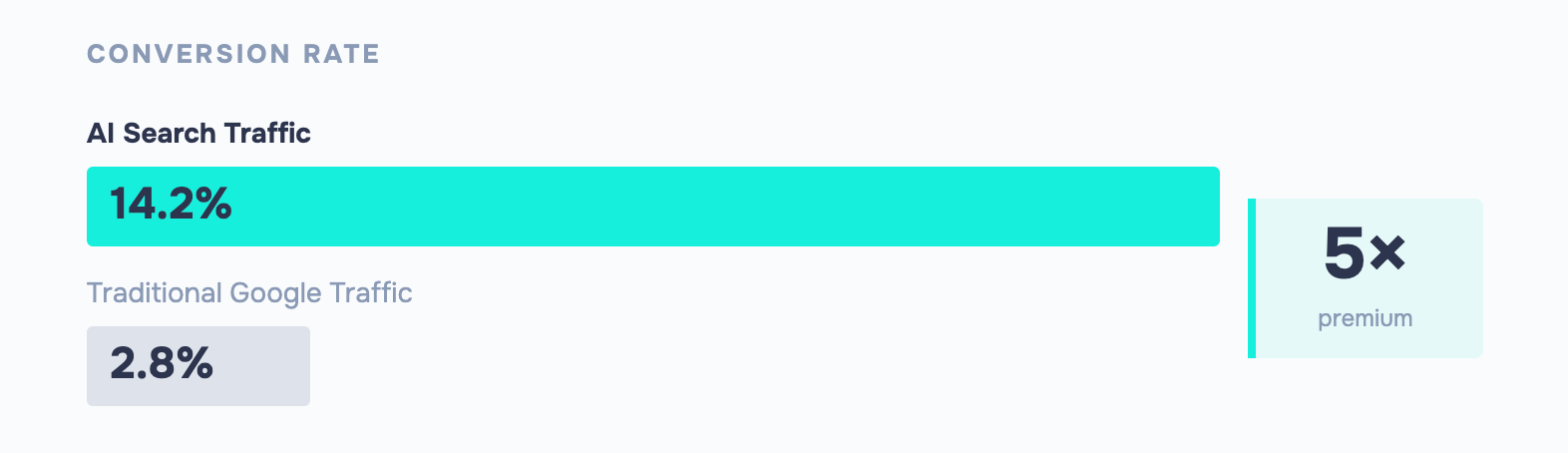
The reason the conversion rate is so high is what you might call the “pre-qualified click.” When someone reads an AI-generated answer that cites your brand and then clicks through to your site, they’ve already been convinced by the AI’s recommendation. They’re not browsing — they’re buying.
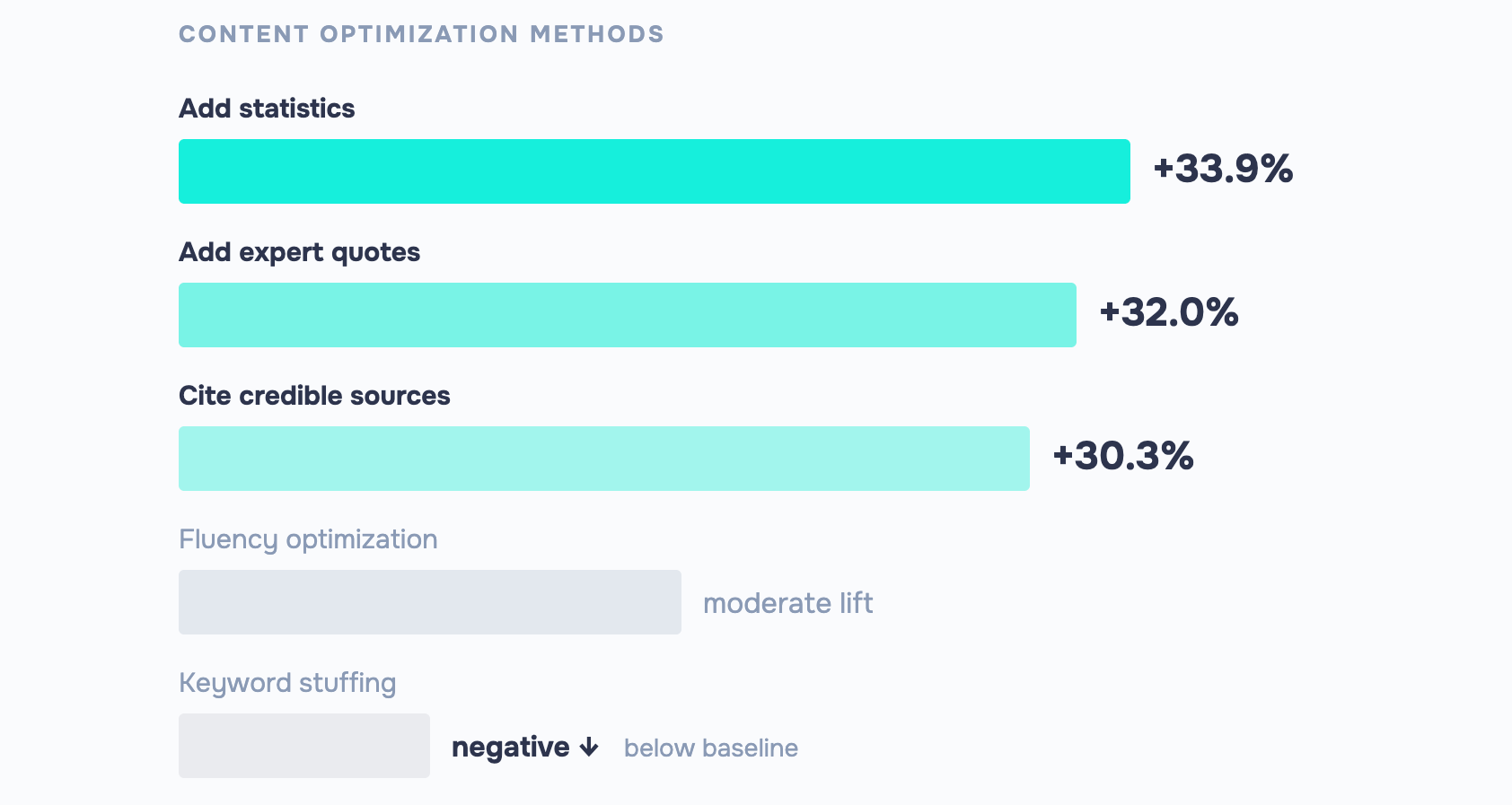
Generative Engine Optimization (GEO) is the discipline of making your content visible inside AI-generated answers. The Princeton/Georgia Tech landmark study (KDD 2024) found that adding statistics to content boosts AI visibility by up to 33.9%, expert quotes by up to 32%, and citing credible sources by up to 30.3%. Critically, these optimizations increased visibility by 115.1% for sites ranked 5th on Google — while the #1-ranked site’s visibility actually decreased by 30.3%.
That’s an inversion of everything SEO trained us to expect. In AI search, challengers with well-structured, data-rich content can leapfrog incumbents who dominate traditional rankings.
Different AI platforms trust different signals. Gemini draws 52% of its citations from brand-owned websites — it trusts what your brand says. ChatGPT trusts what the internet broadly agrees on. Perplexity trusts experts and community voices, with Reddit accounting for 6.6% of its citations. A one-size-fits-all approach won’t work.
The practical framework for GEO readiness: front-load key insights in your content (44% of AI citations come from the first 30% of a page). Structure content in 120-180 word sections between headings (these get 70% more ChatGPT citations, per SE Ranking). Include specific statistics, cite credible sources, and build your presence across third-party platforms where AI draws citations — Reddit, industry publications, review sites, and expert directories.
Only 16% of brands systematically track their AI search performance today (McKinsey). That means 84% of your competitors aren’t paying attention to this channel yet. The window for early-mover advantage is open — but it’s narrowing.
Turning AI Marketing Knowledge into Action
The distance between reading about AI marketing and getting results from it is mostly about prioritization. You don’t need to implement everything in this guide at once. You need to pick the two or three moves that match where you are today.
If you’re just getting started, focus on content creation workflows and email optimization — these deliver the fastest, most visible wins. If you’re already using AI tools regularly, the next move is measurement. Build the ROI dashboard. Run the A/B tests. Prove the value or redirect the investment.
And if you’re ahead of the curve, the opportunity is GEO. The brands that figure out how to show up inside AI-generated answers — not just in traditional search — will capture a disproportionate share of the highest-converting traffic on the internet.
The gap between AI adoption and AI integration is where billions of dollars in marketing value sits unclaimed. The teams that close it won’t be the ones with the most tools. They’ll be the ones with the clearest strategy, the cleanest data, and the discipline to measure what matters.
For teams looking to accelerate — especially in the fast-evolving world of AI-driven search — working with specialists who combine deep AI expertise with proven SEO and GEO strategy can compress months of experimentation into weeks of measurable growth.