
Generative Engine Optimization (GEO) is the practice of structuring your content, technical infrastructure, and brand presence so that AI systems — ChatGPT, Perplexity, Google AI Overviews, Gemini — retrieve and cite your pages when generating answers. If traditional SEO gets you onto page one, GEO gets you into the AI-generated answer itself.
The urgency is hard to overstate. Nearly 60% of Google searches now end without a click. AI Overviews show up on over 25% of all queries — and that number has grown 58% year-over-year. If your content isn’t the source AI cites, you’re handing traffic to a competitor whose content is structured for the way search actually works now.
Here’s the counterweight: visitors who arrive through AI citations convert at 4.4x the rate of traditional organic traffic. The AI citation landscape is also far less crowded than traditional SERPs — only 2–7 sources get cited per AI response, but 47% of brands haven’t even started optimizing for it. That gap between high value and low competition won’t last.
This guide is a practical, priority-ordered GEO checklist for getting your content cited across every major AI platform. Not theory. Not vague principles. Concrete steps, backed by data from recent large-scale studies published in 2025 and 2026.
What AI Search Is and Why It’s Replacing Traditional Results
AI search is what happens when a search engine — or an AI product like ChatGPT, Perplexity, or Google’s AI Overviews — generates a synthesized answer to your query instead of handing you a list of blue links. Google AI Overviews, ChatGPT Search, Perplexity, Gemini, and Microsoft Copilot all do this, each in slightly different ways.
The technology powering most of these systems is called retrieval-augmented generation (RAG). Instead of relying solely on what a language model learned during training, RAG-based systems pull live content from the web, evaluate it for relevance and authority, and then synthesize an answer — citing the sources they drew from.
The numbers tell you why this matters for your business. AI Overviews now appear in roughly 25% of Google searches. ChatGPT processes over 2 billion queries daily and ranks as the 5th most visited website globally. Perplexity handles 780 million monthly queries, up 239% since August 2024.
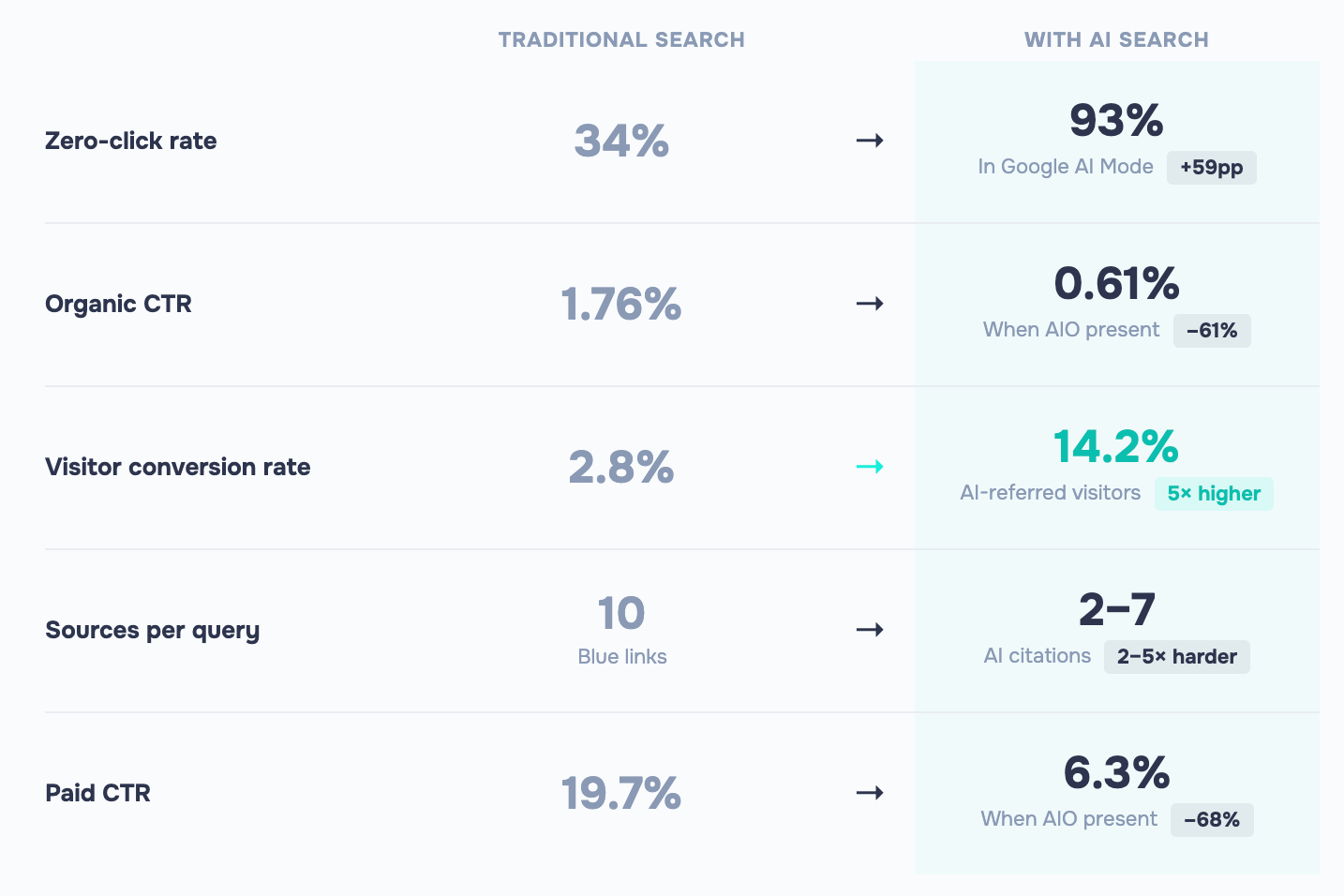
And the click impact is severe. Seer Interactive’s AI Brand Visibility Study — covering over 3,100 queries and 25 million impressions — found that when AI Overviews appear, organic click-through rates drop 61%, from 1.76% to 0.61%. Paid CTR crashes even harder, falling 68%. In Google’s newer AI Mode, zero-click rates hit 93%.
Here’s the contrast that defines the 2026 landscape — traffic is declining while traffic value is increasing:
How AI Models Choose Which Sources to Cite
Understanding the mechanics behind AI citation decisions gives you a strategic edge over people who are just following generic optimization tips.
Google’s AI system doesn’t treat your query as a single question. It decomposes it into multiple sub-queries — typically 3–7, depending on complexity — through a process called query fan-out, then scores potential sources across all of those sub-queries simultaneously. A page that comprehensively covers multiple facets of a topic has a structural advantage over one that nails just one angle. (For a deeper look at how Google’s retrieval pipeline works, see our guide to AI search architecture.)
Here’s the critical insight most guides skip: getting found by AI is not the same as getting cited by AI. Research on hundreds of thousands of pages ChatGPT retrieved found that only about 15% were ultimately cited. The other 85% were evaluated and silently discarded. Your optimization problem isn’t “can AI find me?” — it’s “will AI choose me once it does?”
What matters most at the citation stage is Content-Answer Fit — how closely your page mirrors the structure and tone of the answer the AI itself would write. Studies of 400,000+ pages estimate this accounts for roughly 55% of the citation decision.
Citation counts vary by platform. ChatGPT and Google AI Overviews typically cite 3–4 sources per response. Perplexity is more generous, citing around 5–10. But across all platforms, the competition for each citation slot is 2–5x more intense than competing for traditional organic rankings.
Brand authority acts as a citation multiplier. Ahrefs’ study of 75,000 brands found that those in the top 25% for web mentions earn dramatically more AI citations than those in the next quartile. But you don’t need to be a household name — sites with domain authority between 40 and 80 show citation rates comparable to DA 90+ sites when their topic coverage is strong.
One more data point worth internalizing: only 38% of AI Overview citations now come from pages ranking in Google’s organic top 10, according to the same Ahrefs research. That figure was 76% in mid-2025. The overlap is collapsing fast, which means strong content on mid-authority sites has a genuine window of opportunity.
Content Structure and Writing That AI Can Extract and Quote
Every top-ranking guide covers content structure, so the bar here isn’t mentioning it — it’s giving you rules specific enough to actually implement.
The single most important structural principle: front-load your answers. Analysis of over 1.2 million AI-generated answers and 18,000 verified citations shows a consistent pattern — roughly 44% of citations come from the first 30% of a page’s content. The middle third accounts for about 31%, and the final third just 25%. Traditional “ultimate guide” formats that build to a crescendo at the end are structurally disadvantaged in AI retrieval.
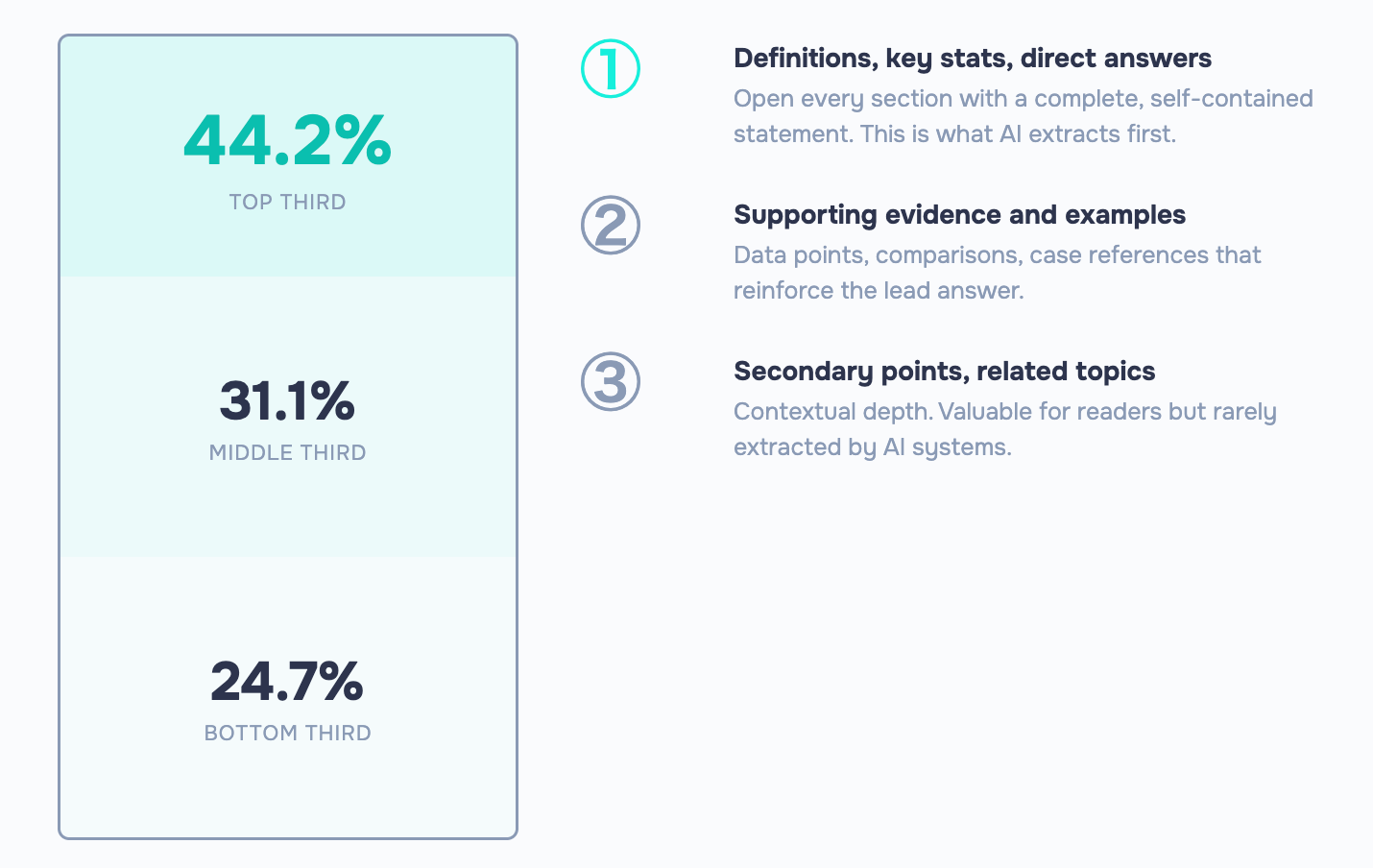
Here are the content formatting rules that the data supports:
- Lead every section with a definition sentence. Google’s Gemini uses text fragment anchoring to pull specific sentences from your page. If the first sentence of a section directly defines or answers the topic of that section’s heading, you’ve given the AI exactly what it’s looking for.
- Write in chunkable blocks. Each paragraph should be a self-contained unit of 40–60 words that can stand alone as a quote. If a paragraph only makes sense in context of the paragraphs around it, it’s poorly structured for AI extraction.
- Keep sections between 120 and 180 words. Large-scale studies of millions of pages found that sections within this range earn the most citations — better than both shorter and longer sections.
- Use question-based H2s. Headings framed as “What is…” or “How do I…” directly mirror the natural language queries people type into AI systems. This semantic alignment increases the chances your section gets matched to a user’s prompt.
- Include statistics with clear attribution every 150–200 words. The Princeton GEO research — the foundational academic study on generative engine optimization — found that adding citations and statistics to content boosts AI visibility by up to 40%. The top three GEO methods they identified were citing sources, adding expert quotations, and including specific numbers.
- Add a TL;DR or summary block at the top of each article. This gives AI systems a pre-structured answer to extract without needing to parse your entire page.
- Don’t keyword-stuff. The same Princeton study found that traditional keyword optimization actually decreased AI visibility by about 10%. Write for clarity and comprehensiveness, not keyword density.
Content length still matters, but not in the way most people think. Articles over 2,900 words tend to average more citations than those under 800 words. But a 1,200-word page with perfect front-loaded structure will outperform a 4,000-word page where the insights are buried in paragraph eight. Length earns citations only when every section delivers value from its opening sentence.
Technical Foundations — Schema, Crawl Access, and Site Performance
Great content sitting on a technically broken site never gets seen by AI. The technical layer is your gatekeeper — it’s binary. Either AI systems can access and parse your content, or they can’t.
Crawl Access
Start with your robots.txt file. Check whether you’re blocking any of these AI crawlers:
- GPTBot — OpenAI / ChatGPT
- ClaudeBot — Anthropic
- CCBot — Common Crawl (feeds several AI training datasets)
- PerplexityBot — Perplexity
- GoogleOther — Google’s AI-specific crawler
Nearly 80% of top news publishers block at least one AI training crawler — and many businesses have inherited restrictive robots.txt rules without realizing the impact on AI visibility.
Beyond robots.txt, check that your content is actually crawlable. Heavy client-side JavaScript rendering causes problems for many AI crawlers. If your page content only loads after JavaScript execution, significant portions of it may be invisible to AI systems. Serve critical answer content in the initial HTML whenever possible.
Schema Markup
Structured data helps AI systems understand what your content is about, who wrote it, and how it’s organized. Implement JSON-LD schema for these types as a baseline: Article, FAQPage, HowTo, Organization, and Author.
The data supporting schema’s impact is compelling. Pages implementing 3 or more schema types have a roughly 13% higher likelihood of AI citation. Controlled experiments have tested identical content with and without well-implemented schema (Article + FAQ + Breadcrumb) — and only the pages with schema appeared in AI Overviews.
FAQPage and HowTo markup deserve priority because AI Overviews are fundamentally answer engines. These schema types mirror the question-and-answer format that AI systems generate, making it easier for them to extract and cite your content.
Google officially says no special schema markup is required for AI features. But the experimental data consistently shows a correlation between well-implemented schema and AI citation. Treat Google’s statement as “schema isn’t required” rather than “schema doesn’t help.”
Validate your schema using Google’s Rich Results Test and the Schema.org validator. Broken or invalid schema is worse than no schema at all — it can confuse AI parsers and reduce your citation probability.
Site Performance
Page speed is one of the strongest technical signals in AI citation selection, and most optimization guides barely mention it. Pages with a First Contentful Paint under 0.4 seconds average roughly 3x more citations than pages over 1.13 seconds FCP. That’s a massive difference based on load time alone.
Target a Time to First Byte under 200ms for optimal AI crawler access. Audit your Core Web Vitals, reduce unnecessary JavaScript, optimize images, and consider whether a speed optimization sprint might deliver faster citation gains than a content rewrite.
Mobile optimization and clean HTML round out the technical foundation. Avoid excessive widget overlays that bury your answer text. The cleaner and faster your page, the easier it is for AI systems to find, parse, and cite your content.
Building Entity Authority and Trust Signals for AI
Entity authority is the degree to which AI systems can confidently identify, verify, and trust your brand as a known entity. This is the most under-discussed pillar of AI search optimization — and the data suggests it might be the most powerful one.
Most guides focus entirely on what’s on your website. But AI models don’t just read your site. They cross-reference claims about you across the entire web, building an entity profile from dozens of sources. If your brand isn’t consistently mentioned across authoritative third-party platforms, on-page perfection alone won’t get you cited.
Entity SEO and Consistency
AI systems map people, companies, and concepts as entities in knowledge graphs. The stronger and more consistent your entity presence across the web, the more confidently AI will cite you.
This means your brand name, descriptions, and key details need to be consistent across LinkedIn, Crunchbase, industry directories, your Google Business Profile, Wikipedia (if applicable), and any other platform where your brand appears. Inconsistencies — different company descriptions, outdated addresses, conflicting founding dates — erode AI’s confidence in your entity.
Earned Media and Off-Site Presence
Here’s a finding that should reshape your optimization priorities: social and community platform citations in AI responses now far outweigh owned content citations — by roughly 4x. Nearly half of AI Overview citations come from community platforms like Reddit and YouTube.
Your website is no longer your primary AI visibility asset. Third-party mentions matter more.
Ahrefs’ 75,000-brand study found that YouTube mentions are the strongest correlating factor with AI Overview visibility among all signals tested. LinkedIn rose from the 11th to the 5th most-cited domain on ChatGPT between November 2025 and February 2026. Reddit shows up in 21% of Google AI Overviews and 46% of Perplexity responses.
Domains listed on review platforms like Trustpilot, G2, and Capterra have a 3x higher citation probability. And domains with significant brand mentions on community platforms like Quora and Reddit see roughly 4x higher citation chances.
The implication is clear: you need a multi-platform citability strategy that goes well beyond your own website:
- YouTube — the strongest correlating factor with AI Overview visibility among all signals Ahrefs tested. Even short explainer videos or data walk-throughs build citation equity.
- Reddit — genuine participation in relevant subreddits feeds Perplexity’s citation pipeline directly (Reddit appears in 46% of Perplexity responses) and boosts AI Overview visibility.
- LinkedIn — rose from the 11th to the 5th most-cited domain on ChatGPT between November 2025 and February 2026. Publishing thought leadership here has direct AI citation value.
- Review platforms — Trustpilot, G2, Capterra. Domains listed on these see roughly 3x higher citation probability.
- Earned media — mentions in authoritative publications, expert roundups, and podcast appearances all feed the entity profile AI systems build about your brand.
E-E-A-T Signals on Your Site
While off-site presence is the bigger lever, on-site trust signals still matter. Implement clear author bios with verifiable credentials. Add Organization schema. Build an “About Us” page that communicates specific expertise, not generic corporate copy. Publish original research with unique data points — this is one of the strongest on-page citation signals across every study in this analysis.
Think of brand mentions as the new backlinks. In traditional SEO, links from authoritative sites boosted your rankings. In AI search, mentions across authoritative platforms boost your citation probability. The mechanism is different, but the principle — earning external validation — is the same.
Platform-Specific Optimization — ChatGPT vs. Perplexity vs. AI Overviews
Only 11% of websites get cited by both ChatGPT and Perplexity. Each AI platform retrieves content differently, favors different source types, and responds to different optimization levers. Treating “AI search” as a single channel is a strategic mistake.
Here’s how the major platforms compare:
| Factor | Google AI Overviews | ChatGPT | Perplexity | Gemini |
|---|---|---|---|---|
| Primary retrieval source | Google index (real-time) | Bing index + training data | Google/Bing hybrid | Google index (real-time) |
| Overlap with Google top 10 | 17–38% (declining) | 6.82% | 91% | High (similar to AIO) |
| Freshness preference | High (85% from last 2 yrs) | Moderate (29% from 2022+) | Very high (50% from 2025) | High |
| Top social source | YouTube (23%) | Wikipedia + Reddit | Reddit (46% of responses) | Varies |
| Web search trigger rate | Always (built into Search) | 31% of prompts | Always | 100% informational, 0% recommendation |
| Sources cited per response | 3–6 | 2–7 | 5–10 | 3–6 |
| Best content type | Comprehensive guides, structured data | Encyclopedic, data-rich | Niche, recent, community-validated | Definition-first, extractable paragraphs |
Google AI Overviews
Google AI Overviews use Google’s existing ranking systems as a base, then layer AI extraction on top. There’s still a correlation with organic rankings, but the overlap between AI Overview citations and traditional top-10 results has dropped to 17–38% according to Ahrefs, accelerated by Google’s switch to Gemini 3, which replaced roughly 42% of previously cited domains.
The key levers are traditional SEO strength combined with structured, extractable content. Pages with strong E-E-A-T signals dominate. 85% of AI Overview citations were published within the last two years, with 44% from 2025 alone — so freshness matters considerably.
ChatGPT
ChatGPT holds over 80% of the AI chatbot market share, making it the single most important platform for most brands. But it behaves quite differently from Google.
ChatGPT only triggers a web search on about 31% of prompts — the rest of the time, it relies on training data and its Bing index integration. This means newer brands face a particular challenge: if you weren’t prominent on the web when ChatGPT’s training data was collected, you need to build off-site authority aggressively to break into its consideration set.
Wikipedia is disproportionately influential, appearing in roughly 5% of ChatGPT’s top citations. The overlap with Google’s top 10 is just 6.82% — meaning ChatGPT citation and Google ranking are almost entirely different games. One nuance worth noting: ChatGPT actually favors older content more than other platforms, with about 29% of its citations from content published in 2022 or earlier.
Perplexity
Perplexity is the freshness engine. It has a 91% correlation with Google’s top-10 rankings for retrieval, but heavily weights recency for citation.
Reddit plays an outsized role — appearing in 46% of Perplexity responses. If your audience is active on Reddit, genuine participation in relevant subreddits directly feeds Perplexity’s citation pipeline. Content updated within 30 days gets significantly more Perplexity citations than stale content. If you’re targeting Perplexity visibility, quarterly content refreshes aren’t aggressive enough — aim for monthly updates on your highest-priority pages.
Gemini
Gemini’s behavior is the most distinctly split. Informational prompts trigger a web search 100% of the time, while recommendation prompts trigger one 0% of the time. This means Gemini’s factual answers come from live retrieval, but its brand recommendations come entirely from training data.
For the content it does retrieve, Gemini performs paragraph-level text extraction with fragment anchoring. Lead with definition sentences. Write paragraphs that can stand alone. Gemini is quite literally pulling specific text fragments from your page — make sure the fragments it grabs are your best ones.
What Works Everywhere
Across all platforms, four strategies consistently correlate with higher citation rates: clear content structure with front-loaded answers, original data and statistics, well-implemented schema markup, and consistent entity presence across the web. These are your universal baseline. Platform-specific tactics layer on top.
How to Track and Measure Your AI Search Visibility
Track AI visibility by monitoring two things: brand mentions (is your brand appearing in AI-generated answers?) and website citations (is your content the cited source?). The gap between these two metrics is diagnostic. If you’re mentioned but not cited, you have an authority problem. If you’re neither mentioned nor cited, you have a visibility problem.
Key KPIs to Track
Five metrics give you a complete picture of your AI search performance:
- Citation Frequency — how often your content appears as a cited source in AI responses for your target queries.
- AI Share of Voice — your citations as a percentage of total citations across your competitive keyword set.
- Brand Visibility Score — the number of AI answers mentioning your brand divided by the total number of relevant answers generated. This captures awareness beyond direct citations.
- AI-Referred Conversion Rate — the conversion rate of visitors arriving from AI platforms, tracked separately from organic. This is the metric that justifies your investment.
- Citation Position — where in the AI response your content appears. First-mentioned sources carry more weight with users.
GA4 Setup
Create a custom AI/LLM traffic channel grouping in GA4 that buckets referrals from chatgpt.com, perplexity.ai, and other AI platforms. This lets you compare sessions, engagement, and conversions from AI referral traffic against your traditional organic channel. Without this setup, AI traffic gets lumped into “direct” or “referral” and you’re flying blind on a channel growing at triple-digit rates.
Google Search Console can also help — use regex filters to identify queries triggering AI Overviews and track your impression and click data for those terms specifically.
Manual Monitoring
Run your target queries across ChatGPT, Perplexity, Claude, Gemini, and Google AI Overviews at least weekly. For each query, log whether your brand was mentioned, whether your URL was cited, which competitors appeared, and what position you held in the response. This is tedious but irreplaceable — no automated tool captures the full picture yet.
A critical reality underscores why weekly monitoring matters: there’s less than a 1-in-100 chance that ChatGPT or Google AI will return the same list of brands in any two responses to the same prompt. Only about 30% of brands stay visible from one AI answer to the next. AI visibility isn’t a ranking you hold — it’s a probability you manage through consistent, broad-base optimization.
Tools and Cadence
The tool landscape is maturing fast. Several platforms now offer AI citation monitoring — from enterprise suites to free options like manual prompt testing combined with GA4 referral data and Google Search Console regex filters.
Set a monitoring cadence that matches the pace of change: daily scans for your most critical commercial queries, weekly brand audits across platforms, monthly competitive analysis comparing your citation frequency against top competitors, and a quarterly strategy review to adjust priorities based on what the data shows.
From Checklist to Competitive Advantage
AI search optimization builds on traditional SEO but adds specific requirements around content architecture, schema implementation, entity authority, and platform-specific tactics. None of these are exotic or inaccessible. Most of them are things strong marketing teams already know how to do — they just haven’t applied them to the AI citation context yet.
The window of opportunity is real and quantifiable. AI-referred sessions grew 527% year-over-year in the first half of 2025. Yet 47% of brands still have no GEO strategy, and only 23% of marketers actively track AI visibility. That imbalance between high-growth channel and low competitive density won’t persist.
Start with a baseline audit: test 10–20 of your target queries across every major AI platform and document where you stand. Then work through the priorities in order:
- Fix technical access first — robots.txt blocks, slow page speed, client-side rendering problems. These are binary gatekeepers; nothing else works until they’re resolved.
- Restructure your highest-value content — front-load answers, add definition sentences, implement schema markup. Focus on the pages targeting your most commercial queries.
- Build off-site entity presence — YouTube, LinkedIn, Reddit, review platforms, earned media. This is the layer most competitors are still ignoring entirely.
- Measure weekly, adjust monthly — set up GA4 AI channel grouping, run manual platform audits, track citation frequency and conversion rates.
The brands that move now — while the AI citation space is still far less crowded than traditional SERPs — will compound their advantage as the market catches up. If you’re looking for a team that specializes in AI search optimization — from technical audits and schema implementation to content structuring and citation tracking — our AI SEO services can help you become the source AI trusts and cites.