
Nearly half of all Google searches now trigger an AI Overview. Most SEO teams are still optimizing for a SERP that no longer describes the majority of searches.
The harder issue is what passes for optimization advice in this space. Schema as a primary citation lever. Content length requirements. Formatting tricks that supposedly force Google’s hand. Most of it is overclaim, and some of it is flatly wrong. The result is teams investing effort in signals that don’t move the needle while ignoring the ones that do.
What follows is a layered framework for AI Overview optimization — starting from what AI Overviews actually are, through the technical and content fundamentals, into the off-page signals most guides skip, and ending with how to measure performance in a way that actually reflects what’s happening.
What Are Google AI Overviews (and How Do They Actually Select Sources)?
AI Overviews are AI-generated summaries powered by Google Gemini that appear at the top of search results for eligible queries. They’re not pulled from a separate database or generated from model memory. Google grounds them in publicly indexed web content through a process called Retrieval-Augmented Generation, or RAG — the model retrieves relevant pages from the live index, then synthesizes an answer from what those pages say.
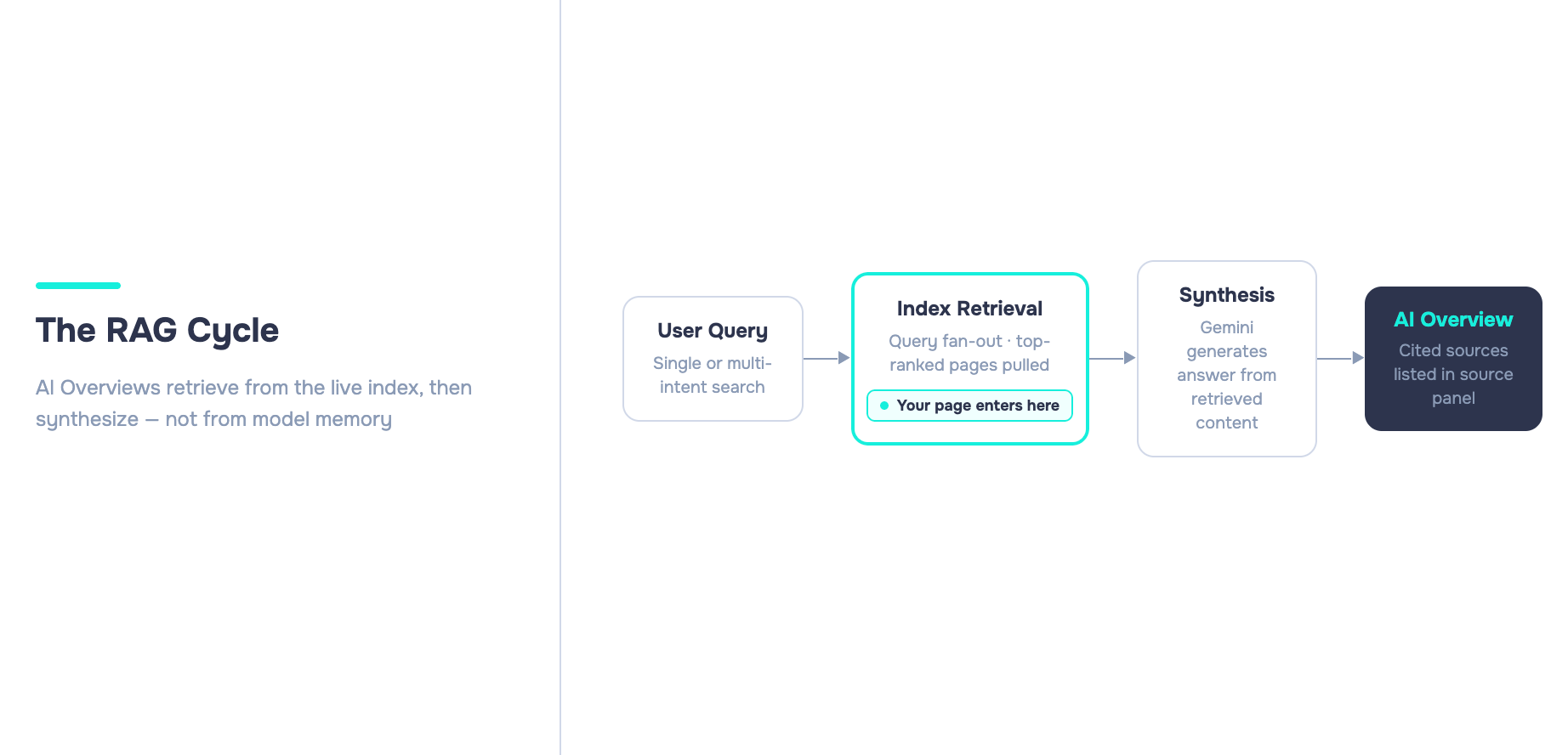
That distinction matters for optimization. There is no secret AI algorithm running parallel to traditional search. The index is the same index.
How Query Fan-Out Works
When you run a search that triggers an AI Overview, Google doesn’t just process that single query. It fans out — running multiple related searches simultaneously to build a more comprehensive picture before generating the response. A question like “how long does it take to learn Python” might spawn sub-queries around programming background, learning methods, daily practice time, and typical benchmarks. The AI Overview synthesizes across all of them.
This is why AI Overviews can cite pages that don’t rank number one for the original query — they’re pulling from the broader retrieval sweep, not just the top result for the surface-level keyword.
AI Overviews vs. AI Mode vs. Featured Snippets
These three surfaces confuse even experienced SEOs. They’re not interchangeable.
| Feature | AI Overviews | AI Mode | Featured Snippets |
|---|---|---|---|
| Trigger | Broad informational queries | Separate search tab (opted-in) | Specific factual or procedural queries |
| Format | Multi-paragraph synthesis with source links | Conversational back-and-forth | Single block excerpt |
| Citation source | Top-indexed web pages via RAG | Broader web + conversation context | The single best-matching page |
| Zero-click rate | High | Very high | Moderate |
AI Mode is a fully separate surface from AI Overviews — it lives in its own search tab rather than appearing inline on the main SERP. Citation patterns, content type preferences, and the optimization implications differ between them. Almost no competitor content covers this distinction. Treating them as synonymous will lead you to draw the wrong conclusions from your data.
Which Queries Trigger AI Overviews
Informational intent dominates. If someone is trying to learn something, compare options, or understand a process, the chances of an AI Overview appearing are high. Transactional queries — “buy noise-cancelling headphones,” “book a hotel in Lisbon” — trigger AI Overviews at much lower rates. Commercial and navigational queries sit somewhere in between.
This isn’t a permanent state. Google continues to expand AI Overview coverage, and trigger rates shift by industry and query complexity. The practical implication: informational content, definitional content, and how-to content are your best bets today.
The Foundation: Traditional SEO Signals That Drive AI Citation
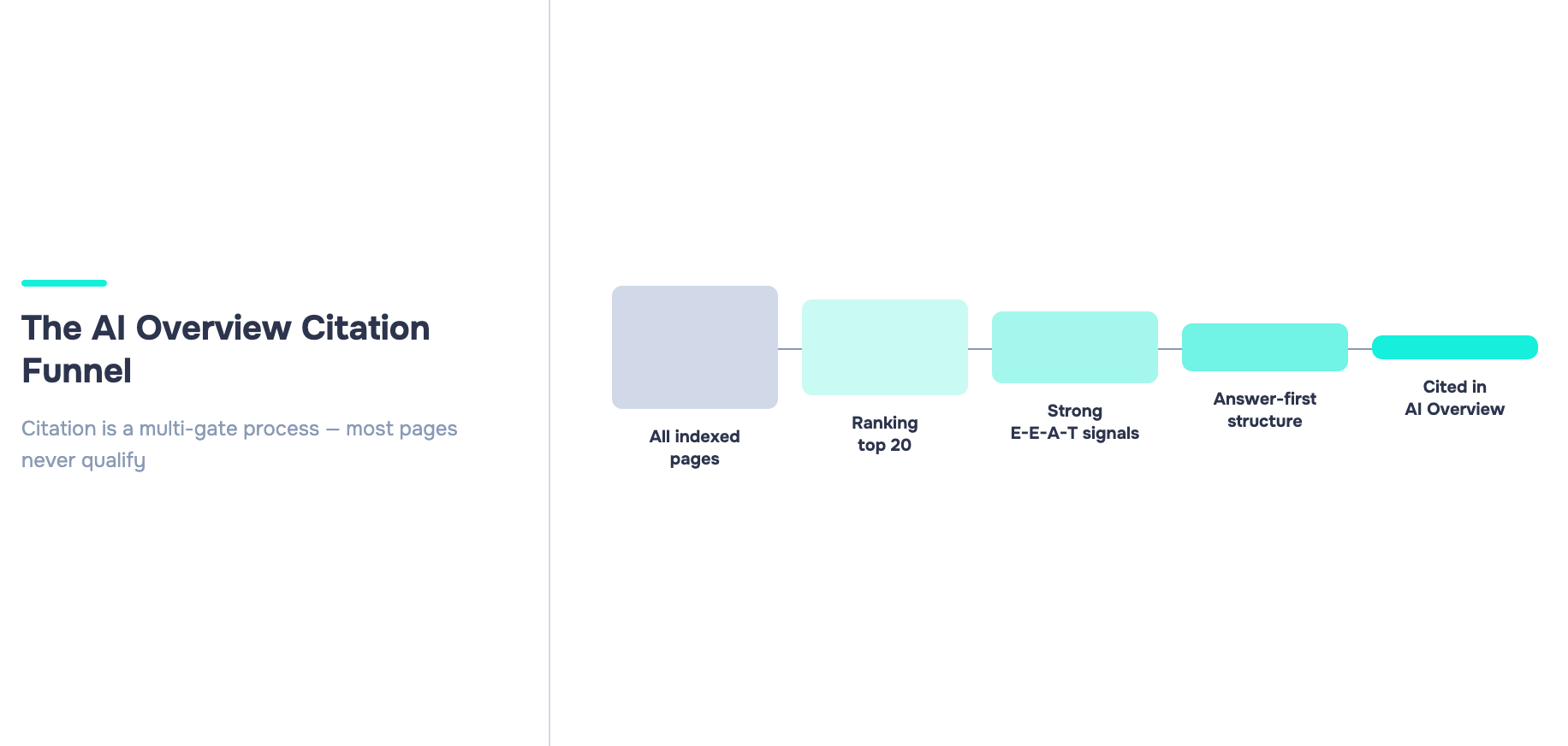
Google has been consistent on one point: AI Overviews draw from the same index as traditional search. No separate AI ranking system. No parallel algorithm. The pages that get cited are, overwhelmingly, pages that already rank.
That makes organic ranking the dominant prerequisite for AI Overview inclusion. Before worrying about answer-first formatting or schema types, ask whether your pages are even in contention. If you’re sitting on page three for a query, you’re unlikely to be cited in the AI Overview regardless of how well-structured your content is.
Technical Crawlability as Baseline
Google cannot cite what it cannot find. Before anything else:
- Crawlability — Clean robots.txt, no accidental noindex directives, no JavaScript rendering that blocks key content from Googlebot
- Core Web Vitals — Page experience signals affect ranking, which affects citation eligibility
- Mobile-friendliness — Google’s index is mobile-first; pages that fail on mobile are effectively penalized
- Indexability confirmation — Regular site:domain.com checks and Search Console coverage reports catch silent indexing failures before they compound
These aren’t AI Overview tactics. They’re prerequisites. Skipping them and jumping straight to content formatting is building on sand.
E-E-A-T Signals
Experience, Expertise, Authoritativeness, Trustworthiness — Google’s E-E-A-T framework predates AI Overviews, but it’s more relevant now than ever. The AI system is drawing on content to answer real user questions. Pages that demonstrate genuine expertise and verifiable authorship are safer bets for citation than anonymous content with no visible accountability.
Practical E-E-A-T signals: author bylines with credentials, visible publication and update dates, first-person experience signals where relevant (the “E” for experience is newer and distinct from expertise), and authoritative external sourcing where claims require it. Author pages that link to verifiable profiles, social accounts, or publications add another layer.
Long-Tail and Conversational Keywords
Short head terms — “email marketing,” “cloud storage,” “project management” — are less likely to trigger AI Overviews than longer, conversational queries. Question-based queries with three to five words are disproportionately likely to trigger AI Overviews. “What’s the difference between IMAP and POP3” is a more viable AI Overview target than “email protocols.”
This has direct implications for keyword strategy. Long-tail content that maps to specific questions, comparisons, or how-to processes is where AI Overview citation potential is highest. It’s also, not coincidentally, where informational intent is clearest and competition is often lower.
Brand Mentions vs. Backlinks
Off-page signals for AI citation are more nuanced than raw link count. External brand mentions across authoritative third-party sites — even unlinked ones — appear to function as strong trust signals for AI systems evaluating source credibility. A well-regarded brand that gets mentioned frequently in industry publications, news outlets, and forums sends a different kind of signal than a site with links but no conversational presence.
This doesn’t mean backlinks are irrelevant. They’re still foundational for organic ranking, which gates AI Overview eligibility. But in the AI era, the question has expanded: it’s not just “who links to you” but “who talks about you.”
Content Structure and Answer-First Formatting
Structure is the highest-leverage on-page factor under your direct control. Most optimization guides mention “answer-first formatting” as a concept without giving writers a usable framework. Here’s what it actually means in practice.
The Front-Loading Principle
The majority of AI citations are drawn from the first 30% of a page. Not the conclusion. Not the middle section where you finally get to the meaty detail. The introduction.
This inverts the traditional SEO approach of burying the lead while building up to the payoff. For AI Overview optimization, your introduction is your most valuable real estate. If the key answer to the query this page targets isn’t in the first few paragraphs, you’re handing citation potential to whoever structured their page better.
Answer-First Structure in Practice
The pattern is consistent across AI-cited content: place a concise, 40–60 word direct answer immediately beneath each H2, then elaborate below it. Each section becomes self-contained — AI systems extract individual sections from longer articles rather than citing the whole piece, so every block needs to work independently.
Before (typical approach):
What is anchor text? When building links, one of the most important factors that SEOs often overlook is the actual text used in the hyperlink. This text, known as anchor text, can take many forms depending on the context and intent of the link. Understanding anchor text is a crucial part of any effective link building strategy…
After (answer-first):
What is anchor text? Anchor text is the clickable, visible text of a hyperlink. It tells both users and search engines what the linked page is about. Exact-match anchor text directly includes the target keyword; branded anchors use the site or company name; generic anchors use phrases like “click here.”
Understanding the distribution of anchor text across your backlink profile matters because…
The difference: the second version answers the question in the first 50 words. A reader (or an AI) that extracts only the opening sentences gets the complete answer. The first version requires reading four sentences before the subject is even properly defined.
Question-Based Headings
Write H2 and H3 headings as full questions that mirror natural language search queries. “What is anchor text?” outperforms “Anchor Text Definition” for AI citation purposes because it matches the format of queries that trigger AI Overviews in the first place. The alignment between query and heading reduces the interpretive work the AI system has to do.
Content Types Most Frequently Cited
Not all content formats are created equal for AI Overview citation. The types that appear most often:
- How-to guides with numbered steps (the procedural format maps cleanly to AI-generated instructions)
- Definition articles answering “what is” questions
- Comparison articles with structured side-by-side breakdowns
- Listicles with clear subheadings on each item (not bullets buried in prose)
Long-form content that sprawls without clear structural signposts gets cited less. Not because it’s too long — because AI systems can’t easily extract discrete, self-contained answers from it.
Structured Data: What Schema Actually Does (and Doesn’t) for AI Overviews
Schema markup is probably the most overclaimed tactic in AI Overview optimization. Several widely-circulated guides position structured data as a primary citation lever. Google’s own documentation says otherwise.
Google’s official position: no special schema is required for AI Overview inclusion. Structured data is not a citation trigger. It is not a ranking factor specific to AI Overviews.
What schema does do is help Gemini parse and categorize content with more confidence — it reinforces E-E-A-T entity signals and improves eligibility for rich results that often appear alongside AI Overviews. The distinction is subtle but important: schema is a trust signal, not a citation button.
Priority Schema Types
| Schema Type | Primary Use | AI Signal Value | Current Status |
|---|---|---|---|
| Article / BlogPosting | Establishes authorship and content type | Reinforces E-E-A-T, helps content categorization | Active |
| HowTo | Maps procedural content with clear step structure | Helps AI parse step sequences | Active |
| Organization | Verifies brand entity across the web | Reduces trust uncertainty for AI systems | Active |
| FAQPage | Was used for FAQ chips in search results | Zero SERP lift since May 2026 | Retired (harmless if deployed) |
One significant update: Google retired FAQ rich results in May 2026. FAQPage schema no longer produces any SERP chip visibility. The markup itself isn’t harmful if it’s already in your templates — but if you’re actively implementing it for AI Overview purposes, it’s not doing what you think it is.
For implementation, JSON-LD is the format of choice. Google explicitly recommends it, it parses faster than Microdata or RDFa, and it sits cleanly outside the HTML body rather than tangling with your content markup.
The bottom line on schema: implement it correctly for Article and HowTo content as part of good technical hygiene. Don’t expect it to get you cited where you weren’t being cited before. The pages earning AI Overview citations earned them through content quality and ranking position, not markup.
Topical Authority and Brand Signals: The Off-Page Layer
Most AI Overview optimization guides treat off-page signals as a footnote — a sentence about “building backlinks” before moving on. That’s a mistake. The off-page layer is where citation authority compounds over time, and it operates differently than traditional link-building.
Topic Clusters vs. Standalone Pages
A single well-optimized page covering a topic is less citation-worthy than a site that demonstrates comprehensive, consistent coverage of that entire topic area. Google evaluates how completely and authoritatively a site covers a subject — not just whether one particular page is good.
The practical architecture: a pillar page covering the broad topic at depth, supported by interlinked cluster pages covering related subtopics in more detail. Each cluster page links back to the pillar; the pillar links out to the clusters. The structure signals to Google (and Gemini) that this site understands the subject end-to-end.
The citation benefit: AI Overviews can draw from any page in a well-constructed cluster, not just the pillar. A single topic cluster can create AI Overview citation potential across dozens of related queries rather than one.
Brand Mention Strategy
The goal is to become the entity that authoritative sources reference when discussing your topic area. That means:
- Editorial mentions in industry publications and news outlets
- Consistent presence in authoritative directories and industry databases
- Appearances in forum discussions and Q&A platforms where your audience actually searches
- Podcast features, expert quotes, and contributor content that put your brand name in contexts Google treats as trusted
Note the distinction from traditional link-building: some of the most valuable brand signals for AI citation are unlinked mentions. A reference to your company in a well-regarded industry publication — even without a hyperlink — tells AI systems that authoritative sources consider you a relevant entity in your space.
Digital PR as an AI SEO Tactic
Editorial placements function as the external citation footprint that AI systems use to verify brand credibility. A company that has been covered by trade publications, quoted in mainstream news, and referenced by industry analysts looks different to Google’s AI systems than a company whose only external signals are links from link-exchange networks.
This is where digital PR and AI SEO converge. The press release pipeline traditional PR teams have run for decades turns out to be one of the better AI Overview optimization tactics available — as long as coverage lands on genuinely authoritative domains, not distribution sites.
Entity Consistency
AI systems need to recognize your brand as a coherent, stable entity. That means consistent name, description, and identity signals across every platform: website, social profiles, Google Business Profile, industry directories, Wikipedia if applicable. Inconsistencies create trust uncertainty. A brand listed as “Acme Digital” on its website, “Acme Digital Marketing” on LinkedIn, and “Acme Digital, Inc.” in external mentions is harder for AI systems to verify as a single reliable entity.
Link-Building vs. Brand Mention-Building
Traditional SEO frames off-page optimization primarily through link acquisition. In the AI Overview context, the frame expands. Being talked about by authoritative sources can matter as much as being linked to by them.
This doesn’t mean stop building links — organic ranking still depends heavily on link authority, and organic ranking gates AI citation eligibility. It means your off-page strategy should pursue both, with explicit attention to editorial brand mention opportunities that may never produce a followed link.
The workflow: identify your pillar topic, map the cluster subtopics, publish and interlink, earn external mentions through PR and digital outreach, verify entity signals are consistent across platforms. That sequence compounds. A site that executes it consistently across twelve months builds citation authority that can’t be replicated by a one-off content sprint.
Measuring AI Overview Visibility: Tracking What Traditional Analytics Miss
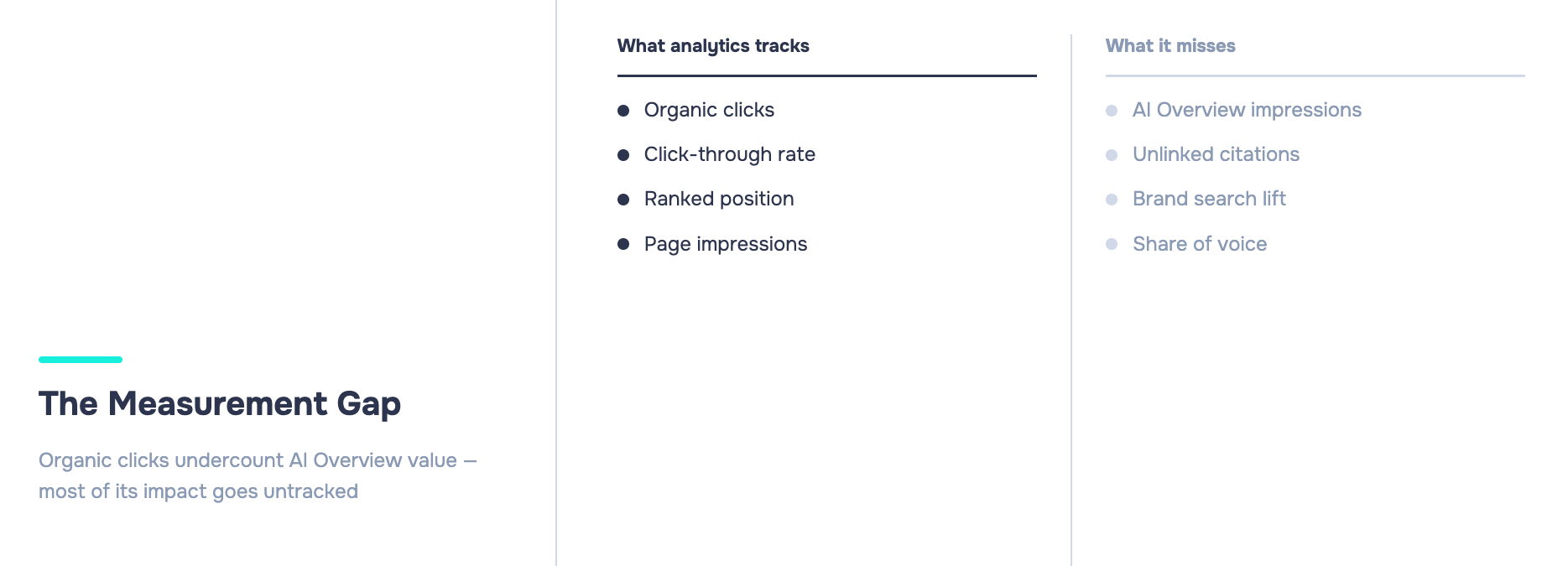
Most teams measure SEO performance through organic clicks. That number is structurally wrong for evaluating AI Overview impact. AI Overviews reduce click-through rates — that’s intentional, that’s the product — while simultaneously delivering brand impressions to the users who see the cited source. A reporting framework built around clicks will tell you AI Overviews are hurting you when they may actually be working.
Google Search Console Limitations
Google Search Console has historically bundled all click types together, making it impossible to separate AI Overview traffic from standard organic clicks. A new generative AI performance report began rolling out in June 2026, though coverage is staggered and not yet universal across all accounts. Check whether your property has access to it under the “Search Results” report.
Even with the new report, GSC data on AI Overview impressions comes with the same sampling and delay limitations as standard GSC data. It’s a starting point, not a complete picture.
Manual Citation Checks
For specific target queries, search Google directly and inspect the AI Overview source panel. The panel lists the pages being cited for that query at that moment. It’s not comprehensive or historical, but it gives you ground-truth data on whether specific URLs are earning citations for your priority keywords.
Build this into regular reporting: a monthly pass through your top 20 or 30 target queries, noting which AI Overviews appear, what format they take, and whether your domain appears in the source panel.
Third-Party AI Tracking Tools
Purpose-built AI tracking tools exist and are improving rapidly. When evaluating them, look for:
- Citation detection (does the tool identify when your URL appears in AI Overview source panels, not just whether you rank?)
- Multi-engine coverage (AI Overviews are the priority, but AI Mode citation patterns may diverge)
- Refresh frequency (AI Overview citations can change daily — weekly data has significant lag)
- Competitive benchmarking (your citation rate only means something relative to what competitors are earning for the same queries)
An AIO-Era Reporting Framework
| Metric | What It Measures | How to Track | Why It Matters |
|---|---|---|---|
| AI Overview impression rate | % of target queries triggering an AI Overview | Manual checks or third-party tool | Shows where AI Overview optimization is relevant |
| Citation frequency by query | How often your URL appears in AI Overview source panels | Third-party tool or manual audit | Direct measure of AIO citation performance |
| Share of voice vs. competitors | Your citations as a % of total AI Overview appearances for your topic set | Third-party competitive tool | Contextualizes raw citation numbers |
| Linked vs. unlinked brand mentions | External references with and without hyperlinks | Brand monitoring tool | Tracks the broader entity signal building |
| Direct brand search volume | Searches for your brand name specifically | GSC branded query data | Rising brand searches signal growing AI-driven recognition even when organic CTR falls |
The shift here is recognizing that being cited without a click still delivers value. Brand recognition accumulates. Direct brand searches tend to increase for brands with consistent AI Overview presence — even as organic CTR for non-branded queries falls. The right interpretation isn’t “AI Overviews are stealing our traffic.” It’s “the attribution model we’ve been using doesn’t capture what’s actually happening.”
AI Overview Optimization Is a System, Not a Checklist
The teams getting consistent AI Overview citations aren’t the ones who added answer-first formatting to three pages and called it done. They’re the ones executing across every layer at once.
The layers build on each other: technical SEO and organic ranking create the eligibility baseline. Answer-first content structure maximizes citation potential from pages already in contention. Structured data reinforces trust signals and aids content categorization. Topical clusters and brand mentions build the off-page authority that makes AI systems confident citing you repeatedly. A proper measurement framework tells you what’s working, what isn’t, and where the gaps are.
One-off page tweaks produce inconsistent results because AI Overview citations depend on the full stack. A well-structured page on a site with weak topical authority and no brand signals will get outcompeted by a moderately-structured page on a site that has demonstrated years of credible coverage in that space.
Auditing the full stack, identifying the highest-leverage gaps, and executing consistently across content strategy, technical SEO, structured data, digital PR, and AIO-specific tracking — that’s where compounding citation authority comes from.