

How to choose a GEO agency: pick the one that shows its prompt set, runs each prompt several times, measures a baseline first and promises no #1 position.
A prompt set is the fixed list of questions an agency types into ChatGPT, Gemini and other assistants to see whether they name you. Generative engine optimization (GEO) is the work of getting AI assistants to name, describe and cite your brand. The same 12 checks show you how to choose an AI SEO agency, an AEO (answer engine optimization) agency or an LLM visibility agency. This guide ranks no agencies, because a list written by an agency that ranks itself is not evidence. Stive sells an LLM Visibility Audit, so we gain if you start with one; score us with the same 12 checks.
The Short Answer: How to Choose a GEO Agency
Choose a GEO agency that shows a fixed prompt set, repeated runs, stated settings and a baseline taken before the work.
- Ask for the method before the case studies. A result with no prompt set behind it cannot be checked.
- Start small. A fixed-scope audit shows whether a retainer makes sense.
- Walk away from guarantees. Brand lists change from run to run.
What Can a GEO Agency Promise, and What Can’t It?
A GEO agency can promise a method, a baseline, specific fixes and honest reporting. It cannot promise a #1 position, a traffic number or a date.
SparkToro and Gumshoe.ai ran 12 brand-recommendation prompts across ChatGPT, Claude and Google’s AI Overviews in late 2025, 2,961 runs in all. ChatGPT and Google’s AI returned the same list of brands less than 1 time in 100. Whether a brand appeared was steadier than where it ranked: four headphone brands showed up in 55% to 77% of 994 responses. The study is not peer-reviewed and was run with an AI-tracking vendor. So the only fair promise is how often you appear across many runs.
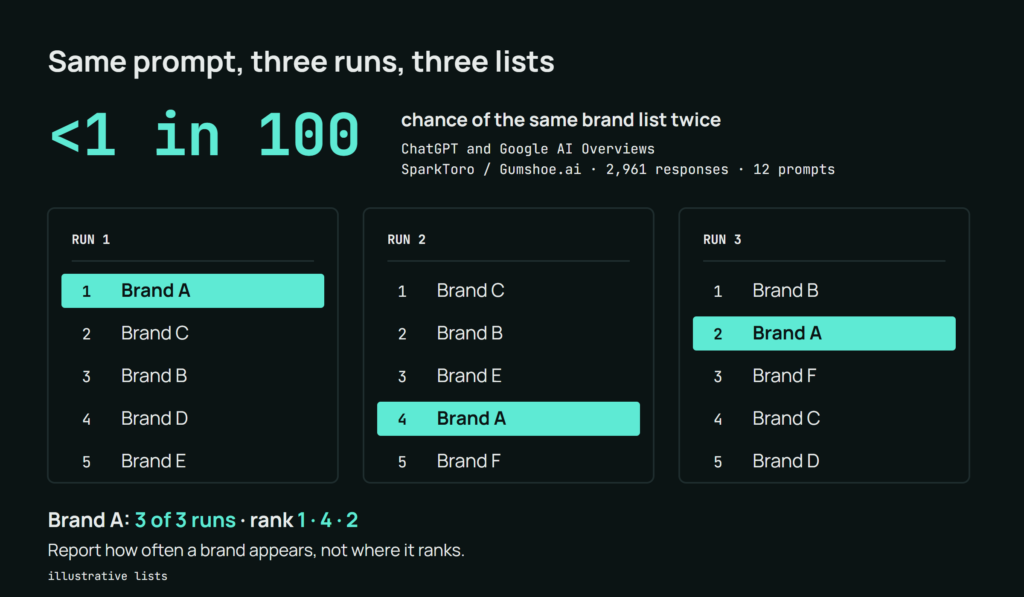
Google’s guidance on hiring an SEO says the same about rankings: no one can guarantee a #1 ranking.
| An agency can promise | An agency cannot promise | Ask instead |
|---|---|---|
| A fixed prompt set and a written method | A #1 position in ChatGPT, Gemini or AI Overviews | “Which prompts, how many runs, which settings?” |
| A baseline before work starts | A traffic, lead or revenue number | “What do you report if the numbers do not move?” |
| Specific fixes: crawler access, indexing, content structure, entity facts, third-party sources | A date by which an assistant will name you | “Which changes, in what order, verified how?” |
| Reporting of mention and citation share, including drops | Control over what a model says | “How do you show a drop?” |
An honest proposal also states what it will not do, what it needs from your team, and what is excluded.
12 Checks Before You Sign a GEO Agency
Run these 12 checks in order before you sign. Measurement details for checks 1 to 5 are in how to measure LLM visibility.
1. Is the Full Prompt Set Shown?
A credible agency shows the full prompt set, grouped by buyer intent, before it shows any result.
- Good answer: a stated number of prompts in types such as vendor choice, task, money and risk, written from real customer wording and frozen between periods. Rates use non-branded prompts only, so your own name cannot inflate the result.
- Walk away if: you get a score with no prompts behind it.
2. How Many Runs per Prompt?
Require at least three runs per prompt per assistant, with the count (n of m) beside every rate.
- Good answer: three or more, with the denominator printed. Three runs is a minimum and proves little: 0 mentions in 3 runs is consistent with a true rate of up to about 56% (95% Wilson interval). Ask for more runs when a decision rides on the number.
- Walk away if: the proof is one screenshot.
3. Are Assistant, Model, Mode, Country and Date Stated?
Every number needs five labels: assistant and model, search on or off, country, account state and date.
- Good answer: all five sit beside each figure, and the agency says whether answers came from the consumer app or an API. API output may differ from what your buyers see, so ask for a manual spot-check of 10 to 20 prompts.
- Push back if: the report says “ChatGPT says” with nothing else.
4. Was a Baseline Measured Before the Work?
Measure the baseline on the fixed prompt set before any content or site change, and measure it twice.
- Good answer: two rounds at least a week apart, so run-to-run noise is known before work starts; a dated change log; and a new baseline when an assistant’s model changes.
- Walk away if: growth is promised with no starting point, or the “baseline” is taken after kickoff.
5. Are the Metrics Defined in Writing?
A report should define mention, citation and share of voice in writing and name the competitors it compares you against.
- Good answer: a mention is the brand named in the answer, a citation is a linked source, and share of voice is your share of all brand mentions across the prompts. The competitor list is fixed before the first run. Branded answers are checked against an agreed fact sheet, so being named wrongly is not a win.
- Push back if: the headline is a composite “visibility score” nobody can rebuild.
6. Is GEO Tied to SEO?
A GEO plan starts with what search already does: crawler access, indexing and pages worth citing.
- Good answer: the agency checks that AI crawlers can read your site (robots.txt, CDN or firewall blocks), separates search crawlers from training crawlers, and confirms indexing in Google and Bing. Google says optimizing for its generative AI search is still SEO.
- Walk away if: you hear “GEO replaces SEO” or “it is only schema markup”.
7. Are Paid Placements and Community Activity Disclosed?
Ask the agency to disclose every paid placement, sponsored list entry and community post, and the identity behind each.
- Good answer: a dated list of URLs, paid items labelled, posts written under real names with the affiliation stated.
- Walk away if: posts come from invented “users”. The FTC’s 16 CFR Part 465 bans fake or false reviews and testimonials, including undisclosed insider reviews and reviews bought for a set sentiment. Whether a forum post counts depends on what it says. This is general information, not legal advice.
8. Is the Proof Something You Can Check?
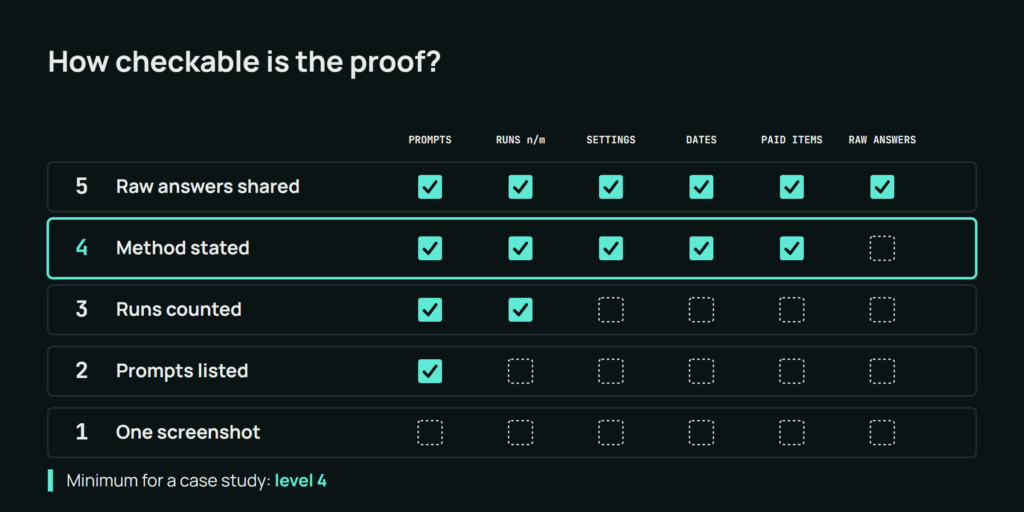
Treat a case study as evidence only if it states the prompts, platforms, dates, runs and what was paid for.
- Good answer: an anonymous client is fine if the method is open; reviews sit on platforms you can open.
- Walk away if: metrics are undefined (“AI reach”) or reviews cannot be found.
9. What Is the Reporting Rhythm, and Do You Get Raw Answers?
Agree a re-run schedule up front and ask for raw answers, not only a dashboard.
- Good answer: the same prompt set re-run on a fixed schedule, an export so you can re-score a sample, a model-version note in each report, and the domains cited for your prompts. The agency also says which AI referrals it cannot attribute.
- Push back if: you only ever see charts.
10. Who Owns the Data?
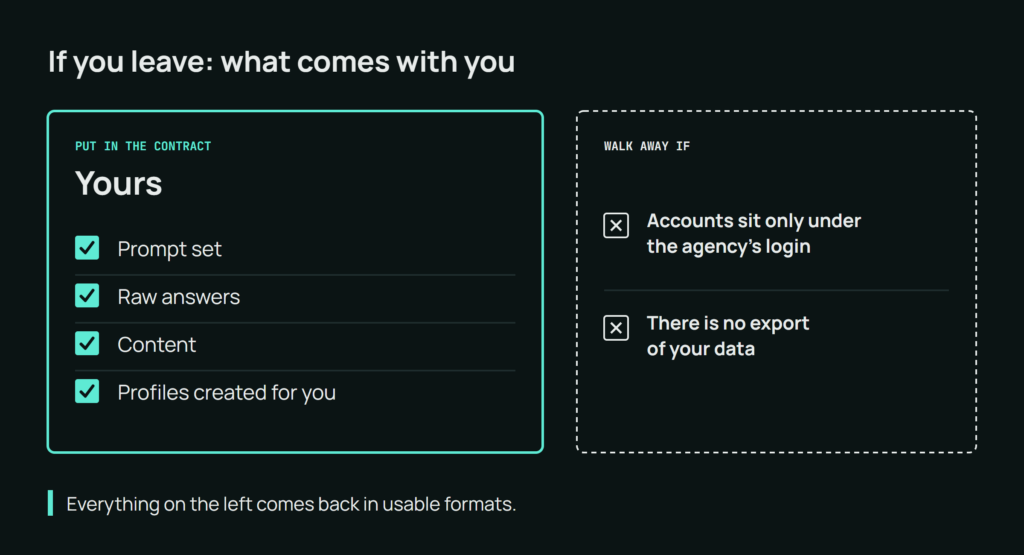
Your contract should say you own the prompt set, raw answers, content and any profiles created for you, and that you receive them if you leave.
- Good answer: a list of deliverables you own, handed over in usable formats.
- Walk away if: accounts sit under the agency’s login with no export.
11. Is the Scope Fixed and the Term Short?
Start with a fixed-scope audit and a short term; commit to a retainer only after the audit shows what to change.
- Good answer: a defined deliverable, a notice period, a review point. Google’s hiring guide also suggests asking what results to expect and in what timeframe.
- Walk away if: a long lock-in precedes any baseline, or the scope reads “optimization”.
12. Can You Verify Who the Agency Is?
You should be able to verify the agency itself: legal entity, named people, a real address and profiles that match.
- Good answer: named specialists, a registered entity, and profiles that describe the same services.
- Walk away if: no one is named, or profiles contradict each other.
What Questions Should You Ask a GEO Agency on the First Call?
Score each agency 0 to 2 on these questions: 0 means vague or refused, 1 means they say it, 2 means they send it in writing.
| Check | Ask this | Verify by |
|---|---|---|
| All | What will you report if nothing improves? | On the call |
| 1 | Can I see every prompt, and who chose them? | Email sample |
| 2 | How many runs per prompt per assistant? | Email sample |
| 3 | Which assistants, model, mode, country and date? App or API? | Email sample |
| 4 | Do you measure a baseline twice before any work, and do I keep it? | On the call |
| 5 | How do you define mention, citation and share of voice? Who picks the competitors? | Email sample |
| 6 | What do you check on my site before changing content? | Email sample |
| 7 | Which placements are paid, and who writes community posts? | Written list |
| 8 | Can you show a case with prompts, dates and runs? | Email sample |
| 9 | How often do you re-run the set? Can I get raw answers? | Email sample |
| 10 | Who owns the prompts, answers, content and profiles if we stop? | Contract |
| 11 | What is in scope, what is the term, how do I leave? | Contract |
| 12 | Who does the work, and where can I verify the company? | Look up (LinkedIn, registry) |
A 0 on check 1, 2, 4 or 10, or any rank guarantee, ends the conversation. Ask each agency to email its prompt list and one sample report: do the prompts sound like your buyers, and is every rate shown as x of y?
GEO Agency Red Flags: What Should You Watch For?
GEO agency red flags: a guaranteed #1, scores with no prompt set, secret access, fake reviews or posts, and hidden text.
| Red flag | Why it fails | Ask |
|---|---|---|
| Guaranteed #1 or guaranteed citations | Brand lists change run to run (SparkToro/Gumshoe); Google says no one can guarantee a #1 ranking | “What do you commit to besides a rank?” |
| Scores or screenshots with no prompt set or run count | Nobody can re-score them | “Send the prompts and the raw answers.” |
| llms.txt as a silver bullet | SE Ranking found no correlation with AI citations across about 300,000 domains; Google Search ignores the file | “What evidence shows it moves citations?” |
| A “special relationship”, “priority submit” or secret access to Google or an AI assistant | Google warns against SEOs claiming a special relationship or priority submit | “What exactly do you have access to?” |
| Fake reviews or posts under invented identities | The FTC’s review rule bans fake or false reviews and reviews bought for a set sentiment | “Who posts, under what name?” |
| “GEO replaces SEO” or “schema only” | Google says optimizing for its generative AI search is still SEO | “What do you fix first on my site?” |
| Relabeled SEO: reports rank and traffic, never the AI answer | It does not measure what assistants say | “Show me an answer you changed.” |
| One assistant only | Answers differ by assistant | “Which assistants, and why those?” |
| Hidden text or content users cannot see | Google’s spam policies list hidden text as spam | “Do you publish anything users cannot see?” |
SE Ranking sells AI visibility tools and does not name the assistants or sample window, so treat its study as one data point.
Should You Hire a GEO Agency, Buy an Audit or Wait?
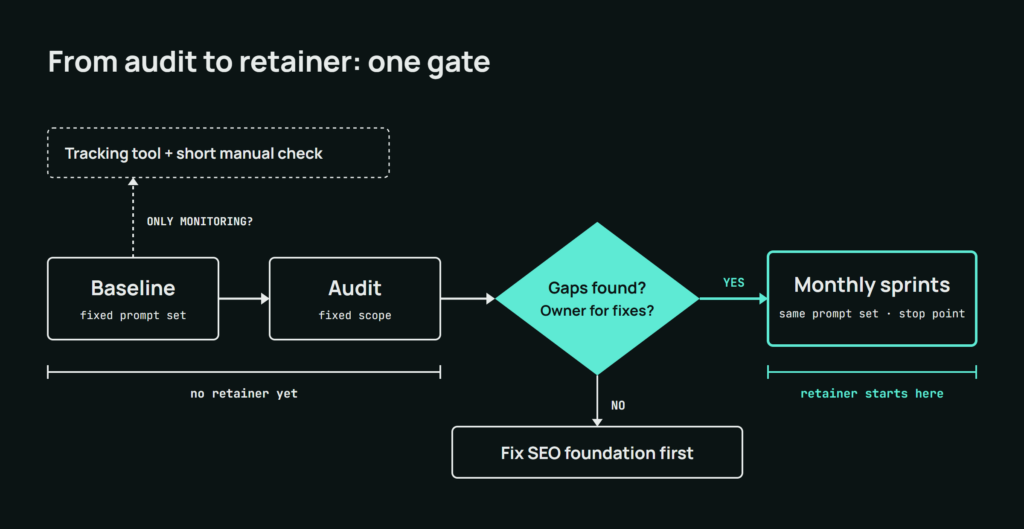
Hire a GEO agency only when you have a baseline, crawlable pages and a team that can ship fixes; otherwise start with an audit or wait.
| Your situation | Start with |
|---|---|
| You do not know whether assistants name you or your competitors | A fixed-scope audit: prompts, platforms, gaps, a ranked fix list |
| The audit shows gaps and your team can ship site and content changes | Monthly sprints with a stop point and the same prompt set re-run each month |
| Your team can run prompt checks and ship fixes | An audit alone may be enough |
| Your SEO foundation is weak (blocked crawlers, thin pages) | Fix the foundation first; an AI-specific retainer comes later |
| Nobody on your side can ship site or content changes | Wait, or fix delivery first; an agency report alone changes nothing |
An audit should end with a fix list another team could carry out: the prompts where you are missing, the pages assistants cite instead, and changes you can verify.
What Should You Prepare Before the First Call?
Before the first call, test ten buyer questions yourself, name three competitors and find out who can change your site.
- Ask ChatGPT and Gemini ten questions your buyers ask, three times each, and note who is named.
- Write down three competitors you want to be compared with.
- Find who holds CMS and Search Console access and who approves content.
- Set a decision date and a budget ceiling; see how much GEO costs.
What Does a Sound First 90 Days Look Like?
A sound first 90 days runs in order: baseline, a ranked fix list with owners, fixes shipped, then the same prompts re-run and compared.
How Stive’s Audit Maps to These Checks
Stive’s LLM Visibility Audit is a fixed-scope, 7-day engagement with no retainer, covering ChatGPT, Gemini, Perplexity and Claude.
- Checks 1 to 3 and 5: the audit follows the measurement protocol published on this site.
- Check 4: the audit is the baseline. It shows the prompts where you are missing and the ones you can win.
- Check 11: the scope is fixed, delivery takes 7 days and there is no retainer.
- Check 12: Founder Vlad Pivnev leads the work, with addresses in Wrocław, Poland, and Bellevue, Washington; profiles on LinkedIn and X.
No agency, Stive included, can guarantee a position in an AI answer. To see where your brand stands, book the LLM Visibility Audit.
Sources
- SparkToro and Gumshoe.ai, AI recommendation consistency study, via Search Engine Journal (30 January 2026): https://www.searchenginejournal.com/ai-recommendations-change-with-nearly-every-query-sparktoro/566242/ ; original report: https://sparktoro.com/blog/new-research-ais-are-highly-inconsistent-when-recommending-brands-or-products-marketers-should-take-care-when-tracking-ai-visibility/
- Google Search Central, “Do you need an SEO?”: https://developers.google.com/search/docs/fundamentals/do-i-need-seo
- Google Search Central, AI optimization guide: https://developers.google.com/search/docs/fundamentals/ai-optimization-guide
- Google Search Central, spam policies (hidden text): https://developers.google.com/search/docs/essentials/spam-policies
- SE Ranking, llms.txt study (about 300,000 domains; page dated 15 October 2026): https://seranking.com/blog/llms-txt/
- FTC, final rule banning fake reviews and testimonials (14 August 2024): https://www.ftc.gov/news-events/news/press-releases/2024/08/federal-trade-commission-announces-final-rule-banning-fake-reviews-testimonials ; rule text, 16 CFR Part 465 (89 FR 68077, 22 August 2024): https://www.ecfr.gov/current/title-16/chapter-I/subchapter-D/part-465
- G2, 2026 AI Search Insight Report: https://learn.g2.com/g2-2026-ai-search-insight-report
- Confidence range for 0 of 3 runs: Wilson score interval at 95%, calculated by the author (see protocol).
About the author
Vlad Pivnev is the Founder of Stive.
Stive is an LLM marketing agency that makes brands visible, accurately described and cited in AI assistants such as ChatGPT, Gemini, Perplexity and Google AI Overviews. Services: LLM visibility audits, generative engine optimization (GEO), LLM reputation management and AI visibility tracking.