
Everyone says “you need both.” That’s true, but it’s also the laziest possible answer. We cross-referenced 30+ data sources to figure out what’s actually different, where the overlap holds, and where the money is.
For years, search had one playing field: Google. You optimized pages, built backlinks, climbed rankings, earned clicks. Simple, linear, measurable. The whole discipline had a clear feedback loop: rankings went up, traffic went up, revenue followed.
In 2026, the playing field split.
When someone asks ChatGPT “best payment processor for e-commerce” or types into Perplexity “compare Revolut vs N26,” they get a direct answer. A shortlist of 3-5 brands. No ten blue links, no scrolling, no comparing tabs. If your brand isn’t in that answer, you’re invisible to a fast-growing chunk of your potential customers — and you probably don’t even know it.
That’s where GEO, Generative Engine Optimization, comes in. Dozens of articles will tell you “SEO and GEO are both important,” but very few explain what’s actually different between them with real numbers behind it. Most just restate the obvious: SEO targets search engines, GEO targets AI. Cool. That still tells you nothing about what to do differently on Monday morning.
We went deeper. We cross-referenced 30+ data sources, analyzed billions of sessions, millions of searches, and thousands of queries across platforms. Here’s what the data actually says.
Where SEO and GEO actually overlap
Start with what hasn’t changed, because the overlap is real and bigger than most GEO vendors want to admit.
76.1% of URLs cited in AI Overviews also rank in Google’s top 10. Sites with more organic traffic consistently earn more AI mentions. Studies of millions of pages confirm that domain traffic is the single strongest predictor of AI citations. High-traffic sites earn roughly 3x more citations than low-traffic ones.
If your SEO fundamentals are weak, GEO won’t fix them. AI systems still rely heavily on the same signals Google uses: backlinks, domain authority, topical depth, E-E-A-T. Industry experts broadly agree the basics of both disciplines come down to the same things: clear structure, authoritative sources, topical expertise. A brand that has neglected SEO for three years won’t suddenly appear in AI answers just because it publishes a few listicles.
Think of it this way: SEO is still the prerequisite. It’s the infrastructure layer that makes your content discoverable and trustworthy. GEO is the layer you build on top of it.
But this is exactly where the “GEO is just good SEO” argument starts to break down.
Where they actually diverge
The overlap holds mostly for Google’s own AI features — AI Overviews and AI Mode. Look at independent platforms like ChatGPT, Perplexity, or Claude, and a different picture shows up entirely.
Rankings and citations are not the same thing. ChatGPT cites content from Google positions 21 and beyond nearly 90% of the time. A brand sitting at position 15 on Google with strong entity clarity and solid third-party mentions can regularly out-cite a number-one result in ChatGPT. The correlation between high organic traffic and ChatGPT inclusion is weak — not nonexistent, but weak enough to matter.
Each platform plays by its own rules. ChatGPT values backlinks about 2x more heavily than Google AI Mode. Perplexity leans hard on Reddit, which accounts for 6.6% of its top citations, and weighs content freshness heavily. Citation volumes for the exact same brand can differ by 615x between platforms. You can dominate in ChatGPT and be completely absent from Claude. These aren’t minor variations — they’re fundamentally different retrieval systems with different trust signals.
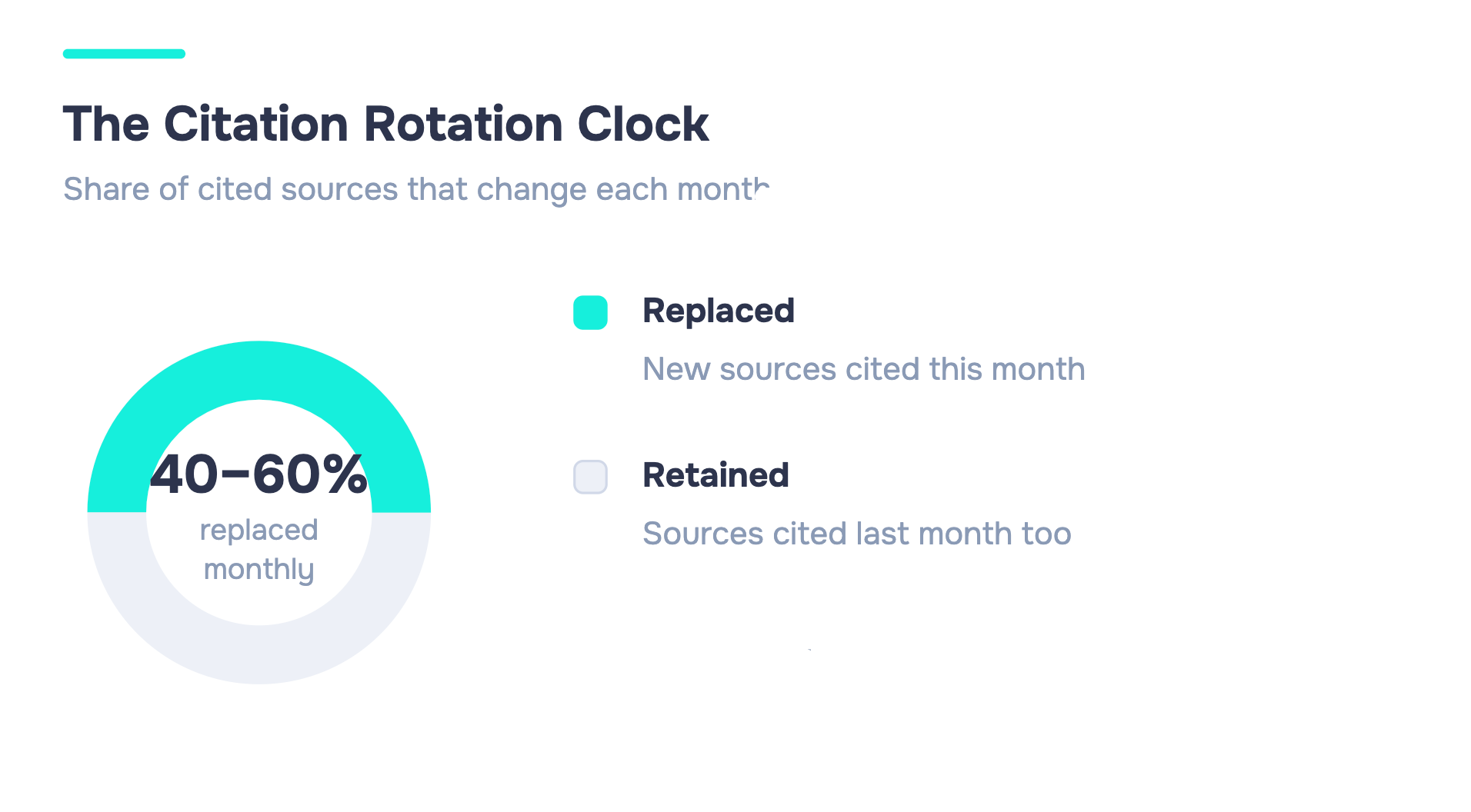
Citations rotate constantly. 40-60% of cited sources in AI responses change every month. In traditional SEO, you can earn a ranking and hold it for months or years with minimal maintenance. In GEO, last month’s citation is this month’s uncertainty. The content that gets cited today may not be cited next month if a fresher, better-structured alternative appears. It’s a treadmill, not a ladder.
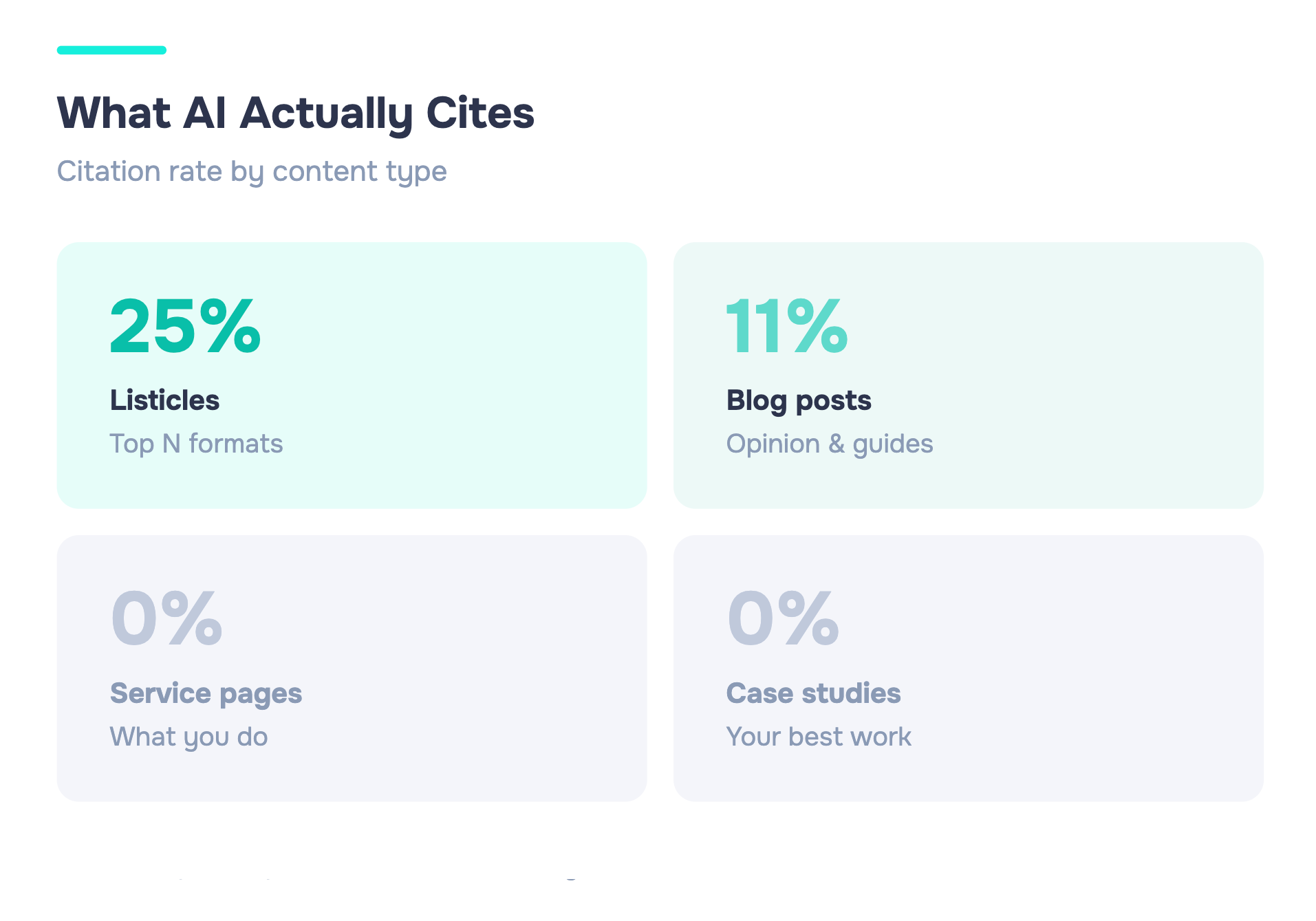
The content format finding is the one that surprises most people. Data from early 2026 shows 74.2% of all AI citations come from structured “Top N” listicle content. Listicles carry a 25% citation rate. Blogs and opinion pieces come in at 11%. Service pages? Zero citations. Standalone case studies? Also zero.
Most B2B websites are built almost entirely around service pages and case studies. That’s the content that explains what you do, demonstrates your work, builds credibility with sales prospects. It’s also the content AI platforms consistently ignore when composing answers.
Small traffic, big money: the AI conversion paradox
Here’s the number that changes how most people think about GEO investment.
AI referral traffic accounts for just 1.08% of total website traffic. That’s a rounding error by traditional marketing standards. Yet visitors from AI platforms convert at 4.4x the rate of organic search visitors. The platform-level breakdown is sharper still:
| Traffic source | Conversion rate | vs. Google Organic |
|---|---|---|
| ChatGPT | 15.9% | 9x higher |
| Perplexity | 10.5% | 6x higher |
| Claude | 5.0% | 2.8x higher |
| Google Organic | 1.76% | baseline |
AI visitors sign up at 10x the rate of traditional search visitors. Retail sessions driven by AI referrals run 38% longer and involve more page views. The conversion premium isn’t a statistical fluke — it shows up consistently across industries and platforms.
The reason is behavioral. By the time someone clicks a link from ChatGPT, they’ve already had a multi-turn conversation. They’ve compared options, asked follow-up questions, and narrowed their choices. They’re not browsing — they’re close to deciding. They arrive further down the funnel than almost any other traffic source, which is why they convert at a completely different rate.
GEO is not a traffic play. It’s a conversion play. Companies measuring GEO success by sessions and pageviews are reading the wrong dashboard.
In absolute revenue terms, volume still wins today. Across a large sample of ecommerce brands, ChatGPT drove a fraction of the total revenue that non-branded organic search produced. But AI-referred sessions are growing at 527% year-over-year while non-branded organic grows at 17%. At those compound rates, the crossover point lands somewhere around late 2027 to early 2028. The brands that build GEO infrastructure now are the ones positioned to capture that shift. The ones that wait will be building it when it’s already table stakes.
The measurement problem nobody talks about
98% of CMOs say they’re investing in answer engine optimization in 2026. But only 16% of brands systematically track their AI search performance. Only 23% of marketers allocate budget to prompt tracking and GEO measurement.
Do the math: roughly 81% of brands whose customers are actively using AI search have no visibility into how they appear in those answers. They’re spending, but they’re spending blind.
Part of why this happens is structural. 93% of AI Mode sessions end without a click. The value GEO creates — brand mentions, citations, recommendations — happens in a space where traditional analytics tools see nothing. You can’t track an AI citation the way you track a keyword ranking in a dashboard. The citation happens, the brand impression registers, the user continues their conversation — and none of it shows up in GA4.
This is GEO’s biggest vulnerability, and simultaneously its biggest opportunity. The brands building measurement systems now — tracking citation frequency, sentiment, and AI share of voice across platforms — will have a compounding analytical advantage as this channel matures. Everyone else is investing based on intuition.
The practical starting point is simpler than it sounds. Filter GA4 right now for referrals from chatgpt.com, perplexity.ai, copilot.microsoft.com, and claude.ai. Compare conversion rates against your organic baseline. Calculate revenue-per-visitor from each AI source. That’s not a comprehensive GEO dashboard, but it’s an honest picture of what AI traffic is actually worth to your business — and that number tends to shift priorities fast.
How SEO and GEO work together: three layers
The most useful way to think about this isn’t SEO versus GEO. It’s three layers of visibility, each building on the one below it.
Layer 1: Infrastructure. Technical SEO, crawlability, site speed, schema markup, backlinks, domain authority. This is the foundation. Without it, nothing else works. AI retrieval systems still need to find, access, and process your content before they can cite it. Skipping this layer and going straight to GEO tactics is like optimizing a page that Google can’t crawl.
Layer 2: Authority. E-E-A-T signals, entity architecture (consistent brand, product, and person definitions across the web), topical depth, third-party presence on Reddit, LinkedIn, YouTube, and industry publications. Both Google and independent AI platforms need to trust your content before surfacing it. This layer is where SEO and GEO overlap most heavily — the signals are similar, even if the mechanisms differ.
Layer 3: Citability. This is the new layer. Direct answers in the first 200 words of every key page. Citation-optimized formats: listicles, comparisons, FAQ blocks. Statistics every 150-200 words with clear attribution. Each section structured as a self-contained answer unit that AI can extract cleanly without context from the surrounding page. Content refreshed every 60-90 days, because freshness is a meaningfully stronger signal for AI citation than it ever was for traditional rankings.
The sequence is fixed. You can’t skip to Layer 3. AI won’t cite content it can’t find or doesn’t trust. But stopping at Layer 2, which is roughly what solid SEO achieves, leaves you invisible to the growing share of discovery happening outside Google’s index entirely.
“GEO is just good SEO”: right now, risky later
The skeptics have a point worth taking seriously. Right now, in mid-2026, most GEO tactics do overlap with SEO best practices. There’s real data showing that articles ChatGPT cited had already ranked on Google. The argument that GEO is just well-executed SEO by another name isn’t wrong for today’s landscape.
But the trajectory matters more than the current state. AI-referred sessions grew 527% year-over-year. Traditional search volume is projected to fall 25%. If those growth curves hold — and there’s no structural reason to think they won’t — AI search visitors could surpass traditional organic within two years.
The window where solid SEO automatically produces GEO results is closing. As AI platforms keep developing independent crawling, indexing, and citation preferences, the two disciplines will diverge further. The platform-level differences we see today — in how ChatGPT, Perplexity, and Claude weight different signals — are early evidence of that divergence, not an anomaly.
The brands building GEO infrastructure while it still looks optional will have a structural lead. That lead is harder to close than it sounds, because AI citation history compounds. Platforms develop familiarity with sources they’ve cited before. Early movers build authority in AI systems the same way early SEO adopters built domain authority in Google — and for similar reasons, it becomes increasingly difficult for late entrants to displace them.
What to do now
Run an AI visibility audit. Take your top 20 revenue-driving queries and test them across ChatGPT, Perplexity, and Google AI Mode. Document where you appear, where you don’t, and who shows up instead. This takes 30-40 minutes and surfaces competitive gaps that no traditional SEO tool reveals.
Fix the content format mismatch. If your site runs primarily on service pages and case studies, you’re publishing in formats AI doesn’t cite. Start producing listicles with specific data, comparison tables, and FAQ-structured guides. Add a direct, extractable answer in the first 200 words of every important page — not a teaser, an actual answer.
Build third-party presence where AI looks. Reddit, LinkedIn, and YouTube are top citation sources across AI platforms. LinkedIn shows up in roughly 11% of AI responses in some categories, and citation rates for LinkedIn content doubled in just three months of 2025-2026. For B2B brands, treating LinkedIn as an AI citation channel rather than just a distribution channel is a meaningful strategic shift.
Measure, even imperfectly. GA4 referral filters for AI sources, conversion rates by channel, revenue-per-visitor from AI traffic. You don’t need a sophisticated dashboard to start. Imperfect measurement beats no measurement when the majority of your competitors are still flying completely blind.
Refresh core content on a schedule. Pages updated within two months consistently earn more AI citations than older content. Build a 60-90 day update cycle for your highest-value pages. Treat freshness as a ranking factor, because for AI platforms, it genuinely is one.
The bottom line
SEO gets your content into the rankings layer. GEO gets it into the answers layer. In 2026, both layers exist simultaneously, they overlap significantly, and they reward different behaviors at the margin.
SEO builds the infrastructure and authority AI needs to find and trust your content. GEO engineers the citability that makes AI confident enough to actually recommend you. Better SEO makes content more discoverable to AI. Better GEO turns that discoverability into citations, and those citations drive high-intent traffic that reinforces authority over time.
The brands winning right now aren’t debating which one matters more. They’re building systems where every piece of content works across both layers. That’s the real difference in 2026 — not a choice between two disciplines, but the recognition that a third thing has emerged from their intersection, and it rewards the companies that treat it seriously before everyone else does.
726