
AI search is reshaping how buyers find businesses — and if you’re reading this, you probably already know that. What you might not know is how to navigate the agency market that’s sprung up around it. The answer engine optimization services landscape is flooded with rebranded SEO offerings, unverifiable claims, and pricing that ranges from $79/month to $50,000+/month with little transparency about what you’re actually getting.
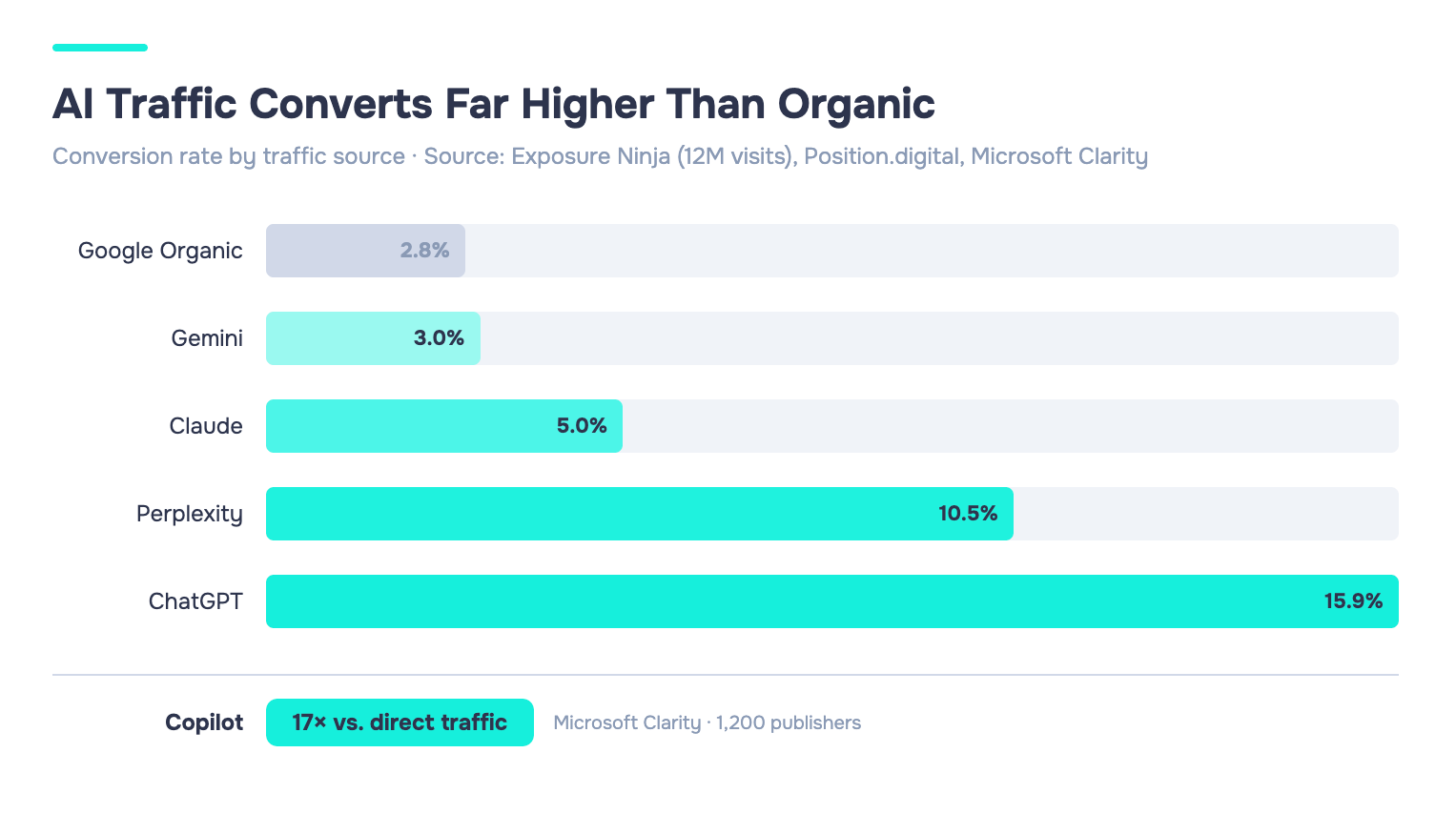
The cost of ignoring AI search is real — brands not optimized for AI platforms are invisible to traffic that converts at 4–5x the rate of traditional organic. But paying thousands per month for rebranded SEO work doesn’t solve that.
This guide gives you the framework to tell the difference.
What Answer Engine Optimization Actually Is (And What It Isn’t)
Answer engine optimization is the practice of optimizing your content to be cited, summarized, and recommended by AI-powered answer engines — platforms like ChatGPT, Perplexity, Google AI Overviews, Gemini, and Copilot. Rather than competing for a position on a search results page, you’re competing for inclusion in an AI-generated answer.
Traditional SEO is about earning rankings. AEO is about earning citations. With SEO you control your page; with AEO, an AI engine decides whether to reference your content, how to summarize it, and whether to attribute it to you at all. You’re influencing rather than controlling.
The Terminology Mess: AEO vs. GEO vs. LLMO
AEO (answer engine optimization), GEO (generative engine optimization), and LLMO (large language model optimization) overlap significantly and the industry hasn’t settled on a standard. In practice, AEO and GEO are used almost interchangeably. For this article, AEO is the umbrella term.
AEO Builds on SEO — It Doesn’t Replace It
At a technical level, most AI answer engines use retrieval-augmented generation (RAG) — querying an index of web content, ranking retrieved chunks by relevance and authority, then synthesizing an answer.
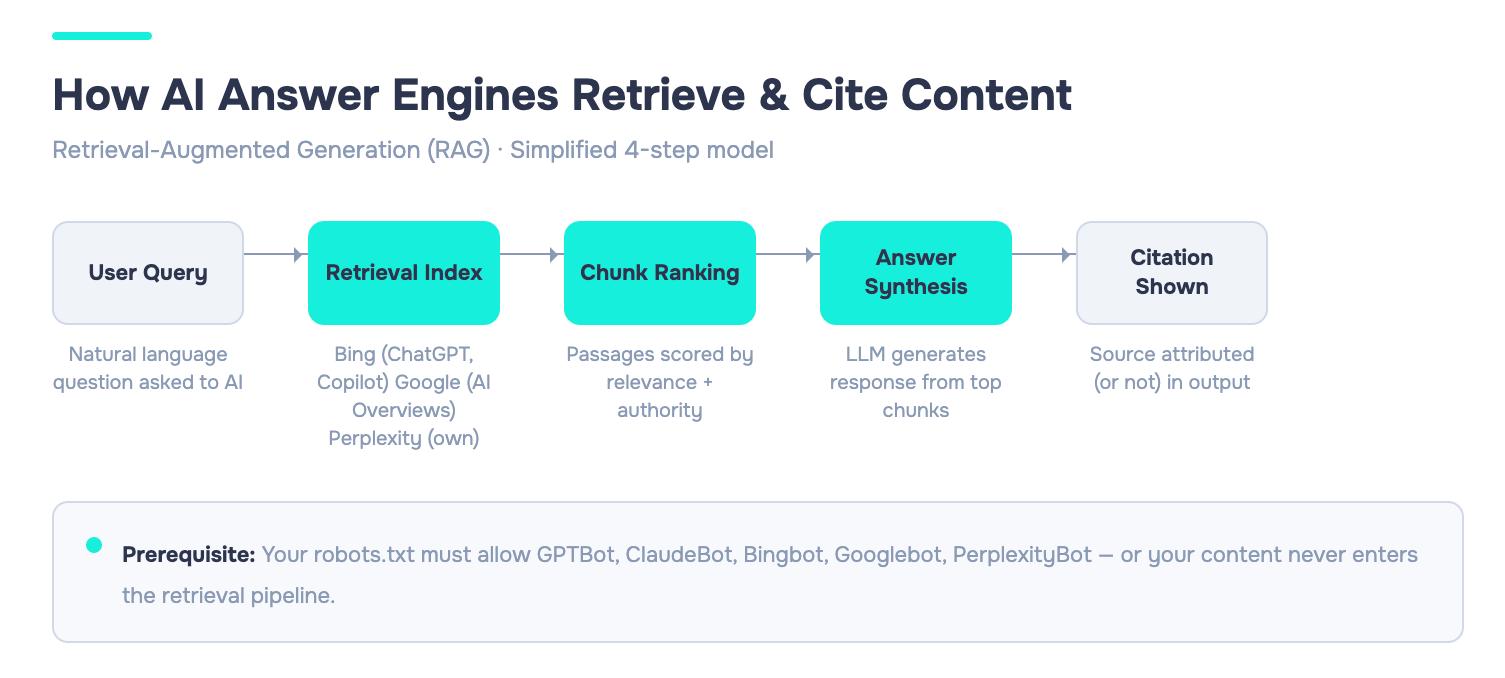
For ChatGPT and Copilot, that retrieval layer is primarily Bing’s index. This has a practical implication many AEO guides overlook: ensuring your site is accessible to AI crawlers — GPTBot, ClaudeBot, Bingbot, Googlebot, PerplexityBot — via your robots.txt is a baseline prerequisite. If you’ve blocked any of these bots, your content can’t enter the retrieval pipeline regardless of how well it’s optimized.
Core Services an AEO Agency Should Deliver
Genuine answer engine optimization services fall into five categories. Understanding these helps you evaluate whether an agency is offering real AEO work or just repackaging what they’ve always done.
- AI visibility audit and baseline assessment. Reviewing your brand’s current mentions and citations across AI platforms, entity presence mapping in knowledge graphs, and competitive benchmarking. A thorough audit typically runs $2,500–$5,000 as a standalone engagement.
- Structured data and schema implementation. Adding FAQ, HowTo, Organization, Product, and Service schema to key pages, aligning entity markup with “sameAs” links, and ensuring structured data is complete. This overlaps heavily with good technical SEO — necessary but not sufficient for genuine AEO.
- Answer-first content optimization. Restructuring content so key answers appear in concise, citable blocks (75–120 words per target question), with clear heading hierarchies and semantic HTML. Writing that directly addresses the questions people are asking AI platforms, not just keywords.
- Authority and citation building. Digital PR for earning brand mentions in sources AI engines trust, community presence strategy on Reddit and Quora, and consistent brand signal building. SE Ranking’s data makes the case: content quality alone doesn’t earn AI citations. Authority does.
- Multi-platform monitoring and reporting. Tracking brand mentions across five to seven AI platforms, conducting regular prompt testing, and analyzing citation frequency, sentiment, and competitor presence.
Categories one, four, and five are what separate real AEO agencies from agencies that added “AI” to their SEO service page. Any SEO shop can implement schema and restructure headings. The agencies worth hiring actually monitor citations across platforms, build authority through channels AI engines trust, and report on AI-specific metrics.
How to Evaluate and Choose the Right AEO Agency
Choosing an AEO agency in 2026 requires more scrutiny than choosing a traditional SEO partner. The market is newer, the methodologies are less standardized, and the gap between what agencies claim and what they deliver is wider.
Before you talk to a single agency, understand your starting point. Query ChatGPT, Perplexity, and Gemini with the prompts your customers would use. Document where you appear, where you don’t, and what the AI engines say about you. This takes an afternoon and gives you a baseline no agency can spin.
When evaluating agencies, rate each across five dimensions:
1) Citation tracking capability. Does the agency monitor brand mentions across five or more AI platforms? Do they use dedicated tools like Scrunch, Profound, Otterly, or Rankscale? An agency that can’t demonstrate real-time multi-platform citation tracking is not doing AEO.
2) Authority building methodology. Does the agency include digital PR, community strategy, or third-party citation building? Do they address Reddit’s outsized role in what AI engines cite? Content optimization alone addresses less than half the equation.
3) Measurement and reporting specificity. You want to see citations, mention frequency, share of answer, AI referral traffic, and conversion attribution — not just rankings and organic sessions. Ask to see sample reports.
4) Platform strategy differentiation. Superlines data (March 2026) found the same brand can see citation volumes differ by 615x between platforms. An agency optimizing for “AI search” as a monolithic channel is ignoring fundamental differences in how each platform cites content.
5) SEO foundation integration. The best AEO agencies acknowledge the relationship between domain authority and AI citation probability and can audit your existing SEO foundation as part of the engagement.
Questions to Ask During Discovery Calls
- “Which specific AI platforms do you optimize for, and how does your approach differ across them?”
- “Can you show me a case study with actual AI citation data — not just organic traffic growth?”
- “What does your reporting dashboard look like? Can I see a sample?”
- “What contract structure do you offer?”
That last question matters more than you’d think. Agencies offering month-to-month contracts are signaling confidence in their methodology.
Red Flags When Hiring an AEO Agency
They guarantee AI citations or placements. AI outputs are non-deterministic. Any agency making placement guarantees either doesn’t understand how these systems work or is being deliberately misleading.
They can’t explain how AEO differs from SEO. If the answer boils down to “we add schema markup and structure your FAQs,” you’re looking at rebranded SEO.
Their reporting is all traditional SEO metrics. If success metrics are keyword rankings and organic traffic, they’re measuring SEO outcomes, not AEO outcomes.
Pricing below $2,500/month for “comprehensive” AEO. Meaningful prompt research, multi-platform monitoring, content creation, schema implementation, and ongoing optimization are not economically viable at this price point.
They require 12-month contracts with no trial period. Established AEO agencies that are confident in their results tend to offer shorter commitments. Long lock-in contracts often indicate an agency relying on retention rather than performance.
They claim AEO is “only about schema markup.” Schema helps AI engines understand your content structure, but it doesn’t address authority, doesn’t build citations across platforms, and doesn’t influence how AI engines evaluate your brand’s trustworthiness.
AEO Pricing — What to Expect
| Tier | Monthly Range | Core Deliverables | Best For |
|---|---|---|---|
| Entry | $1,500–$3,500 | Schema audit, basic content optimization, limited monitoring | SMBs testing AEO |
| Mid-Tier | $3,500–$7,000 | Multi-platform monitoring, content optimization, entity building | Companies ready for structured AEO |
| Full-Service | $5,000–$15,000 | Comprehensive strategy, digital PR, authority building | Mid-market brands extending into AI search |
| Enterprise | $10,000–$50,000+ | Dedicated team, custom reporting, multi-brand/market | Large organizations, competitive verticals |
The most AEO-specialized agencies tend to price in the $4,000–$8,000/month range with month-to-month contracts. The most expensive agencies ($15,000+) tend to be full-service firms bundling AEO into broader engagements. Price is a poor quality signal in this market.
The ROI case rests on conversion data: AI search traffic converts at 14.2%, compared to 2.8% for Google organic. Platform-specific figures show ChatGPT at 15.9% and Perplexity at 10.5%. These advantages are strongest for considered purchases — SaaS, professional services, B2B. E-commerce conversion data is more mixed. Any agency that blanket-cites the 14.2% figure without discussing your business model is oversimplifying. The data is real — the context matters.
How to Measure AEO Success
Conductor’s 2026 report found data quality and trustworthiness of AI visibility insights was the number one technology challenge for AEO programs. The most important question to ask any agency: “Show me exactly how you measure AI visibility, and what tools you use.” If the answer involves only traditional SEO metrics, they’re not doing AEO.
The metrics that matter: citation frequency across platforms, brand mention share of voice in your category, AI-referred traffic and its conversion rate, entity coverage in knowledge graphs, and prompt-level performance from regular testing.
| Tool | Platforms Tracked | Starting Price | Key Feature |
|---|---|---|---|
| Scrunch | ChatGPT, Perplexity, Gemini, Claude, Copilot, AI Overviews | ~$100/mo | Multi-platform citation tracking with competitive benchmarking |
| Profound | ChatGPT, Perplexity, Gemini, AI Overviews | ~$150/mo | Deep prompt-level monitoring and brand mention analysis |
| Otterly | ChatGPT, Perplexity, Gemini, AI Overviews | ~$100/mo | Automated prompt testing with historical trend tracking |
| Rankscale | ChatGPT, Perplexity, Gemini, Claude | ~$200/mo | Platform-specific citation scoring and recommendations |
An agency using dedicated tools signals genuine AEO capability. If they rely solely on Google Search Console and a rank tracker, their monitoring infrastructure doesn’t match the channel they claim to optimize.
On timelines: technical fixes show impact in weeks, content optimization in one to three months, authority building in three to six months or more.
Is Your Business Ready for AEO?
Not every business should be hiring an AEO agency right now. Most credible practitioners will tell you the same thing.
Signs you’re ready: Your organic presence is stable but AI visibility lags. Competitors appear in AI answers for queries you used to dominate. You’re seeing declining click-through rates despite steady impressions. Your audience includes B2B buyers or younger demographics — nearly 35% of Gen Z in the U.S. already use AI chatbots to search
Signs you should focus on SEO first: Major technical issues, thin content, minimal domain authority. Remember the data — domain authority is the strongest predictor of AI citations. Investing in AEO before building an SEO foundation is optimizing the wrong layer.
If you’re on the fence, a standalone AI visibility audit ($2,500–$5,000) is the right first step. It tells you where you actually stand before you commit to a retainer.
Future-Proofing Your Visibility
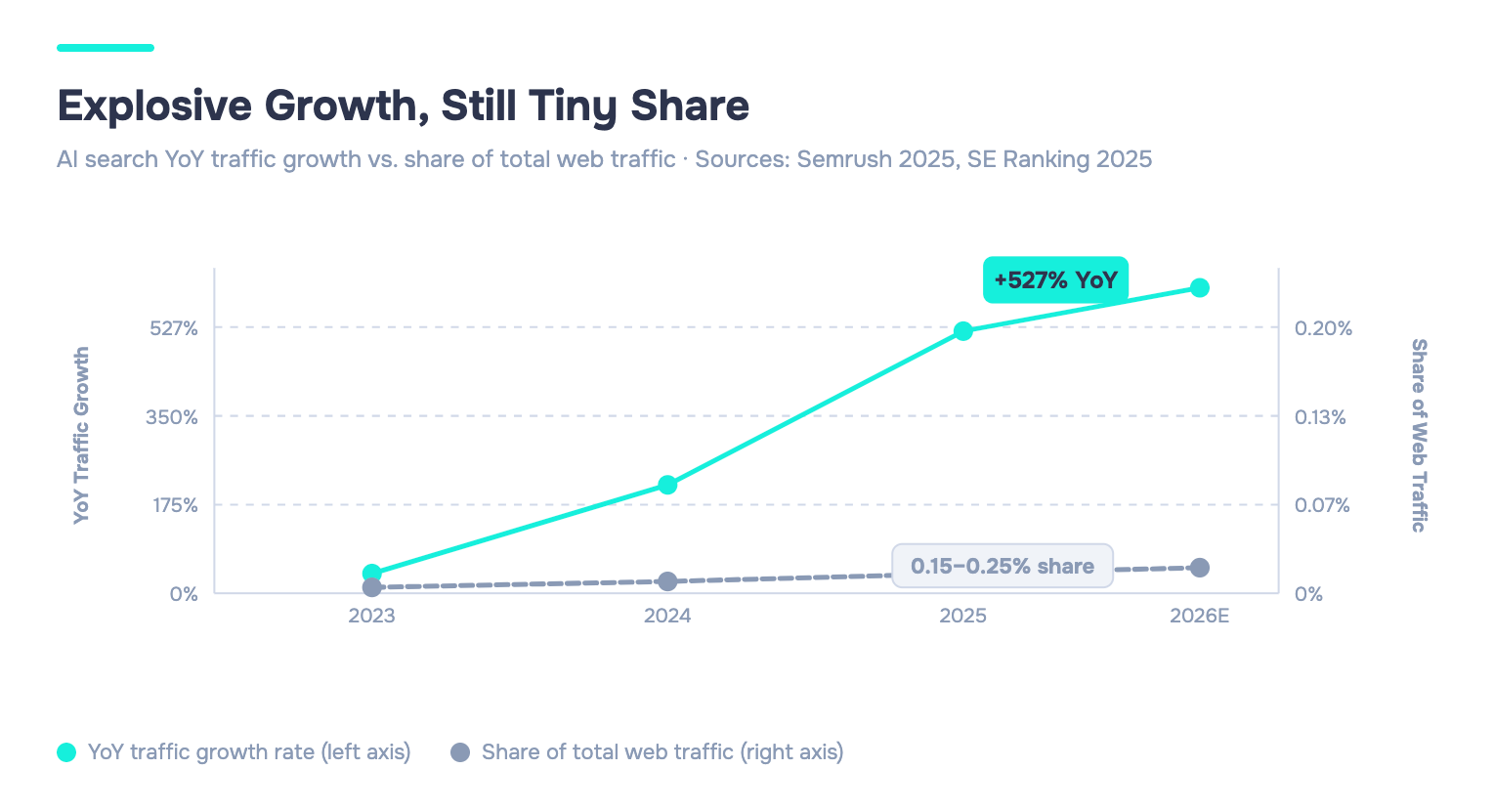
The AEO market in 2026 has a supply problem disguised as a demand boom. The demand is real — AI search grew 527% year-over-year, conversion rates are compelling, and early movers compound their advantage as the channel matures. But the supply of agencies delivering genuine AEO work hasn’t caught up.
The evaluation framework is straightforward: multi-platform citation monitoring, authority building through channels AI engines actually trust, AI-specific metrics in reporting, differentiated strategy by platform, and integration with your existing SEO foundation. Budget 10–15% of digital marketing spend as a starting benchmark. Insist on short-term or month-to-month commitments until results are proven.
The brands that invest intelligently now are building something that compounds. The key word is intelligently — choose the right partner, measure what matters, and build on a foundation that’s real.