
Nearly 60% of Google searches now end without a single click. ChatGPT serves over 800 million users every week. Google AI Overviews now appear in more than 25% of searches — double the rate from a year ago. If your content isn’t surfacing inside AI-generated answers, it’s becoming invisible — even if it ranks on page one.
Answer engine optimization (AEO) is the practice of structuring your content so that AI-powered platforms — Google AI Overviews, ChatGPT, Perplexity, Bing Copilot, and voice assistants like Siri and Alexa — can understand, trust, and cite it as a direct answer to user queries. Where traditional SEO earns clicks from a list of blue links, AEO earns citations and brand mentions inside AI-generated responses.
How Answer Engines Actually Work — The RAG Pipeline Explained
Answer engines run on a process called Retrieval-Augmented Generation (RAG). Understanding this pipeline is what separates strategic AEO work from guesswork.
The Five Stages of RAG
- Query interpretation. The AI parses the user’s question semantically — understanding intent, not matching keywords.
- Retrieval. Candidate documents are pulled from the index based on conceptual similarity, not exact keyword matches.
- Ranking and selection. Documents get scored on relevance, domain authority, freshness, structural clarity, and corroboration across sources. SE Ranking’s study of 2.3 million pages found domain authority is the single strongest predictor of AI citations.
- Answer generation. The AI synthesizes a response by extracting facts and explanations from top-scoring documents.
- Citation. Specific claims are attributed to source documents — the links you see in Perplexity or AI Overview results.
Traditional SEO optimizes for stages 1 and 2 — getting discovered. AEO optimizes for stages 3 through 5 — getting selected, extracted, and cited.
Why Platform Differences Matter
Each AI platform handles this pipeline differently. Google AI Overviews correlate strongly with traditional rankings — about 76% of cited URLs also rank in Google’s top 10. But ChatGPT has the weakest correlation with Google rankings, leaning on sources like Reddit and Wikipedia. According to Conductor’s 2026 benchmarks report, ChatGPT drives 87.4% of all AI referral traffic, yet it sources content very differently from Google’s AI features.
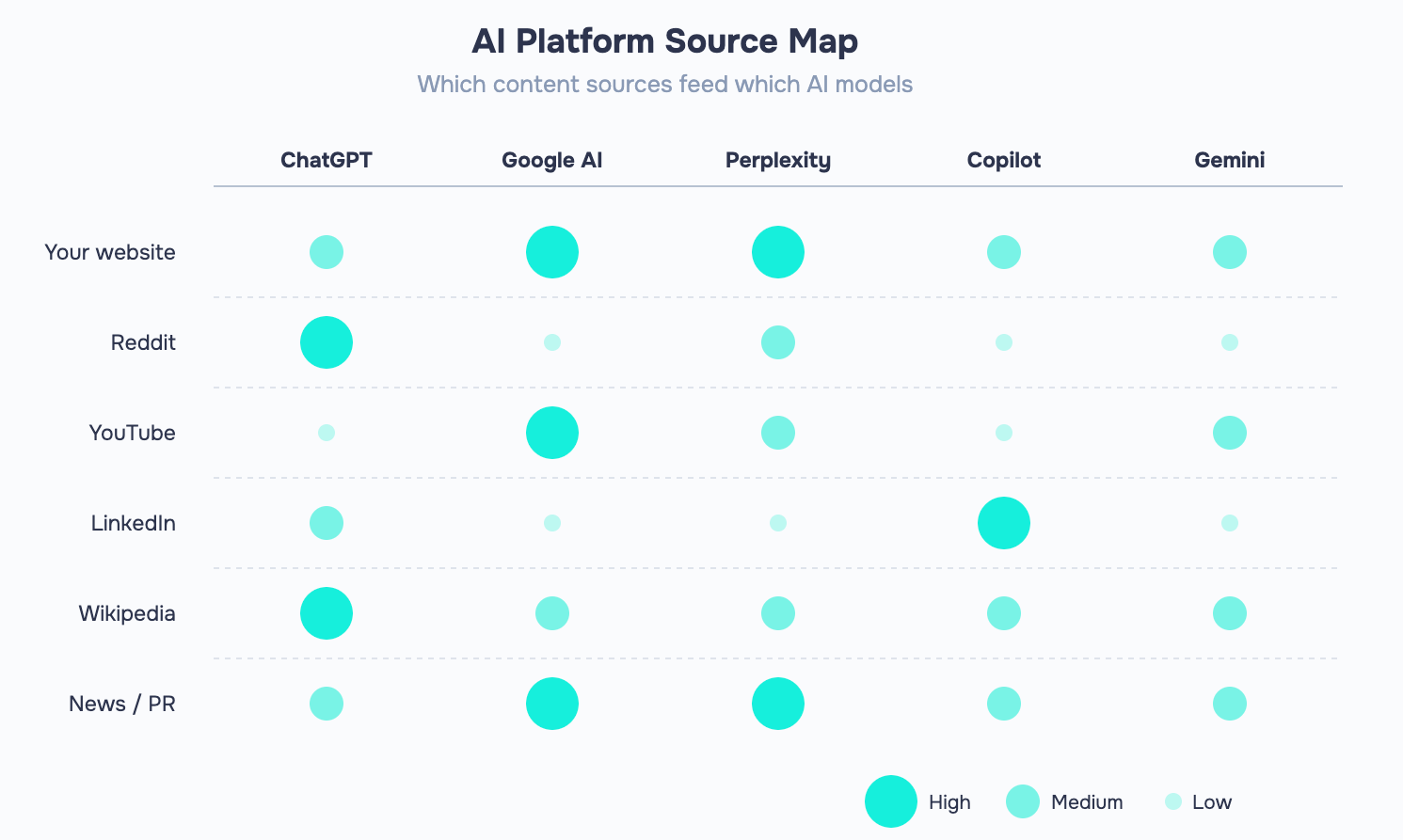
A strategy built exclusively around Google AI Overviews leaves you invisible to the largest AI traffic driver.
Key point: AEO optimizes for the selection, extraction, and citation stages of the RAG pipeline — the stages traditional SEO doesn’t address.
AEO vs. SEO vs. GEO — What’s the Difference (and How They Work Together)
AEO does not replace SEO — they are complementary disciplines. But they’re not identical, and the three-way relationship with GEO (Generative Engine Optimization) causes real confusion.
| SEO | AEO | GEO | |
|---|---|---|---|
| Goal | Rank in search results | Get cited in AI answers | Influence all generative AI output |
| Primary platforms | Google, Bing SERPs | AI Overviews, ChatGPT, Perplexity, voice assistants | All LLM-powered surfaces |
| Key tactics | Keywords, backlinks, technical optimization | Answer-first structure, schema, extractable content | Multi-platform distribution, brand sentiment, entity optimization |
| Success metrics | Rankings, traffic, CTR | Citations, mentions, AI share of voice | Brand perception in AI, competitive positioning |
Where They Converge
All three reward quality content, strong E-E-A-T signals, solid domain authority, and topical depth. Google’s Danny Sullivan has publicly stated that good SEO is good GEO or AEO. SEO veterans like Greg Boser argue we should just change the “E” in SEO from “Engine” to “Experience.”
Where They Diverge
Roughly 38% of AI Overview citations come from pages outside Google’s top 10 organic results. Something beyond traditional ranking signals influences which content gets cited — structural extractability, answer-first formatting, freshness, cross-platform brand presence. That additive layer is what AEO specifically addresses.
For most teams, the practical advice is simple: optimize well for one, and the others benefit. But if you’re only tracking rankings and organic traffic, you’re missing the citation layer where an increasing share of your audience makes decisions.
Key point: AEO, SEO, and GEO share the same foundation but diverge on success surfaces — strong SEO is the prerequisite, AEO is the citation layer, and GEO is the broader influence strategy.
Core AEO Strategy — How to Optimize Your Content for Answer Engines
Confirm AI Crawler Access First
AI platforms use dedicated crawlers to index your content: GPTBot (ChatGPT), Google-Extended (Gemini/AI Overviews), ClaudeBot (Claude), PerplexityBot (Perplexity), and Bytespider (ByteDance). Your robots.txt configuration determines whether these engines can cite you at all.
- Blocking GPTBot removes your content from ChatGPT’s retrieval pool entirely
- Some CMS templates or security plugins block AI bots by default — audit yours
- Allow all major AI crawlers unless you have a specific legal reason not to
- If you block selectively, understand the per-platform tradeoff: blocking Google-Extended affects AI Overviews; blocking GPTBot affects 87% of AI referral traffic
Structure Content for Extraction
Every page and major section should open with a 30–60 word direct answer to the question the heading implies. Think of each passage as “atomic” — it should make sense on its own without requiring surrounding context. This is mechanical, not stylistic: AI systems extract passage-level content, and a clean lead answer gets pulled far more often than a conclusion buried in paragraph four.
Frame H2s and H3s as natural-language questions. “What is schema markup?” beats “Schema Markup Overview” every time — AI models pattern-match queries against headings.
Implement Relevant Schema Markup
Prioritize schema types that match each page’s actual purpose:
- FAQPage — for pages answering common questions
- Article / BlogPosting — for editorial and blog content
- HowTo — for procedural guides and tutorials
- BreadcrumbList — for site structure clarity
Google limited FAQ rich results for most sites in August 2023, so FAQPage schema no longer guarantees visible rich results. But schema still aids machine readability for ChatGPT, Perplexity, and Copilot.
Build Trust and Stay Fresh
Answer engines favor content they can identify as trustworthy. The signals that matter:
- Expert bylines with real credentials
- Inline citations to authoritative sources
- Visible publication and “last updated” dates
- Quarterly content refreshes — 83% of AI citations for commercial queries come from pages updated within 12 months
Earn Off-Site Presence
LLMs pull heavily from third-party sources, and which platforms matter depends on the AI model:
- Reddit → feeds heavily into ChatGPT responses
- YouTube → dominates Google’s AI surfaces
- LinkedIn → picked up by Copilot and DeepSeek
On-site optimization alone covers half the equation. Building presence on the platforms each AI model favors is how you earn citation coverage across the full ecosystem.
How to Measure AEO Success — Metrics, Tools, and Tracking
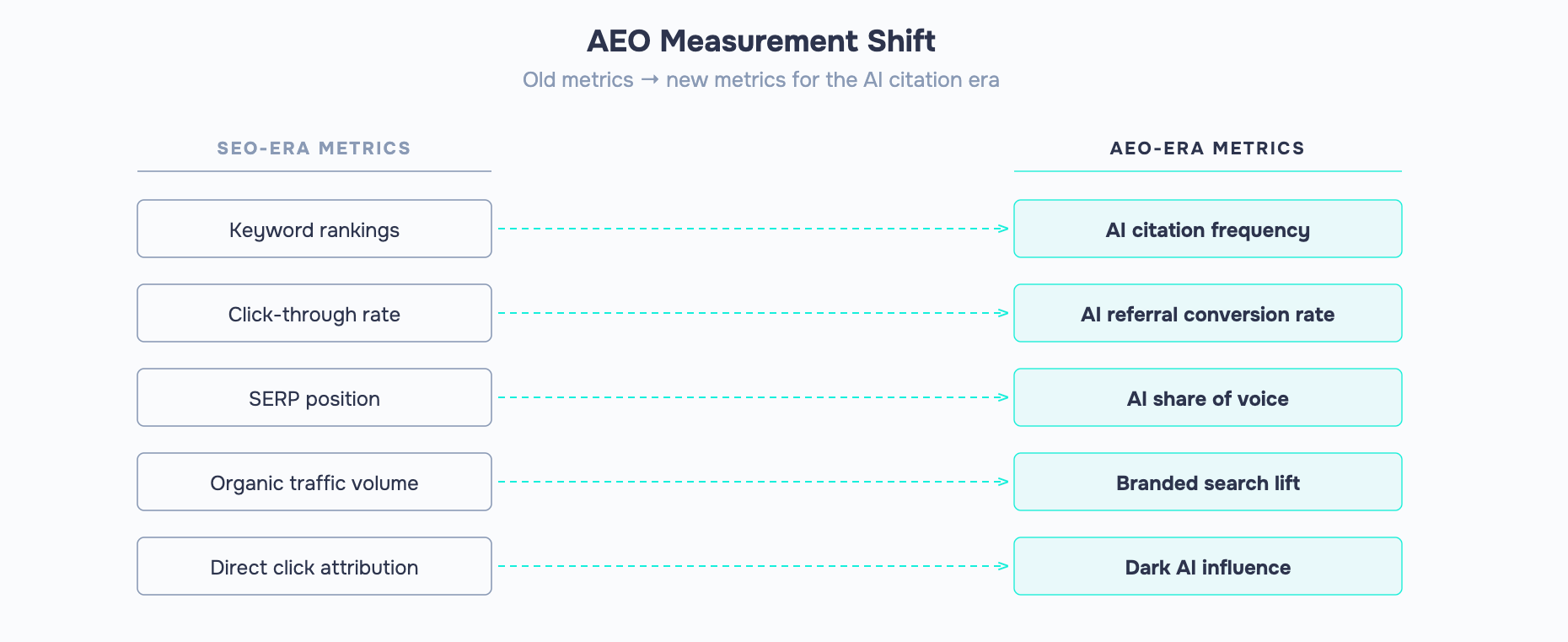
AEO success is measured by how often and how favorably AI systems cite your brand — not by traditional rankings or traffic volume alone.
AEO Metrics vs. SEO Metrics
AEO’s biggest impact is often invisible in standard analytics. When an AI engine cites your brand and the user decides without clicking, that influence never appears in GA4. It may surface later as a branded search query, but the original AI touchpoint goes untracked without dedicated measurement.
Tools and DIY Tracking
The dedicated tooling ecosystem includes Profound (enterprise share-of-voice across five AI engines), AIclicks (prompt-level visibility), HubSpot AEO Grader (free brand audit), Semrush AI Visibility Toolkit, Conductor AI Search Performance, Ahrefs Brand Radar, Otterly, and Superlines.
For teams without budget for specialized tools:
- Test target queries directly in ChatGPT, Perplexity, and Google AI
- Create GA4 custom channel groupings for AI referral sources (chatgpt.com, perplexity.ai, etc.)
- Monitor Search Console for high-impression/low-click queries (snippet indicators)
- Add “How did you first hear about us?” to post-purchase surveys to capture dark AI influence
Expect initial visibility changes in 30–90 days, with full momentum building over 3–6 months.
Key point: AEO measurement tracks citations, brand mentions, and AI share of voice — not just rankings and traffic — because the highest-value AI influence often happens without generating a click.
AEO in Action — Real-World Results and What They Prove
The strongest argument for AEO is the conversion data. Semrush’s AI Search Study found that AI search visitors convert at 4.4x the rate of traditional organic visitors. Other studies confirm the pattern — independent analyses from Microsoft Clarity, Similarweb, and Rocket Agency all show AI-referred traffic converting at 2x to 9x higher rates. Ahrefs published data showing 0.5% of their visitors came from AI but drove 12.1% of signups — a 23x conversion premium.
Why? Because AI compresses the decision journey. In traditional search, someone browses five to ten results, compares, then decides. With AI, the comparison happens inside the conversation — users arrive at your site pre-qualified.
Beyond conversion rates, the revenue impact is real. NerdWallet reported 35% revenue growth despite a 20% traffic drop, attributed to maintained AI citation visibility. Surfer SEO disclosed that roughly 25% of new customers now originate from AI assistants. Broworks achieved 10% of organic visits from generative engines within 90 days, with 27% converting to sales-qualified leads.
The speed at which AEO can shift competitive positioning is striking too. One prop trading platform went from zero AI visibility to the #1 recommendation across five major LLMs in 90 days — covering 15+ high-intent commercial queries in ChatGPT, Google AI Overviews, and Perplexity simultaneously. The approach combined AI-optimized content clusters, strategic PR placements on sources LLMs trust, and continuous citation monitoring. That kind of result underscores a recurring theme: brands that build genuine authority signals across multiple platforms compound their AI visibility faster than competitors can catch up.
The pattern: AEO’s ROI appears as improved lead quality and conversion rates, not more traffic volume. Only 16% of brands systematically track AI search performance — the majority are flying blind on a channel that may already drive meaningful revenue.
Common AEO Mistakes to Avoid
1. Skipping foundational SEO. AEO builds on SEO — it doesn’t bypass it. Research shows 99% of URLs cited in Google’s AI Mode appear in the top 20 organic results. Fix crawlability, speed, and structure first.
2. Treating AEO as a one-time project. AI models update constantly and source preferences shift. Content that earned citations six months ago can lose them to fresher competitors. Plan for quarterly refreshes and continuous monitoring.
3. Prioritizing schema volume over relevance. Implementing every schema type on every page dilutes the signal. Match schema to each page’s actual purpose — FAQPage for Q&A content, HowTo for procedural content, Article for blog posts.
4. Ignoring off-site signals. AI models pull from Reddit, YouTube, LinkedIn, Wikipedia, and industry publications. On-site optimization alone covers half the citation equation. If your brand isn’t present where AI models source from, you’re leaving visibility on the table.
5. Measuring AEO with SEO metrics. Rankings and traffic don’t capture AI citation performance. A page can rank fifth on Google and never appear in a single AI response. Layer AI-specific tracking alongside traditional analytics.
Positioning Your Brand for the AI-First Search Era
Seventy percent of marketers say AEO will impact their strategy within three years, but only 20% have started implementing. That gap is a first-mover advantage for brands that act now.
The action sequence is clear:
- Audit your foundation — confirm SEO health and AI crawler access in robots.txt
- Restructure priority content — add answer-first formatting and relevant schema
- Stand up AI tracking — even a manual version measuring citations, not just traffic
- Build off-site presence — target the third-party platforms each AI model actually sources from
- Commit to freshness — quarterly content refreshes, because AEO rewards recency as much as quality
The brands that treat AEO as a strategic priority will own the citation layer that increasingly determines who gets chosen and who gets ignored.